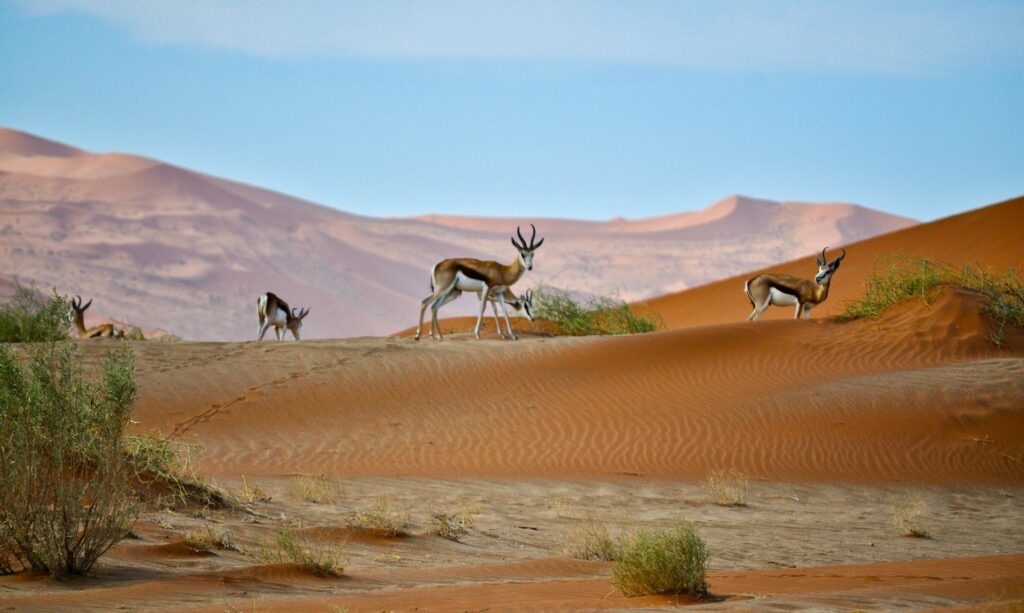
Namibia is a country that defies expectations at every turn and in every single way. It is a place where golden dunes replace skyscrapers, where there are desolate salt pans instead of endless parking spaces, and a coastline that feels like it belongs to another world entirely.

There are plenty of extremes here and it makes nature feel larger than life and it is a place where the term “survival of the fittest” takes on a whole new meaning.

As one of Africa’s most unique travel destinations, no matter how much you read about Namibia, it will surprise you.

One moment you’re gazing at a herd of elephants drinking from a waterhole, and the next, you’re standing in awe of the way the desert meets the ocean along the Skeleton Coast. No matter where you go, there’s something extraordinary to take in.

For travellers planning their journey, one question looms large: When is the best time to visit Namibia?

The answer isn’t as simple as you might think as it all depends on what you want to experience.

From epic safaris to the magic of desert rains, your timing can shape your Namibian holiday in ways that you might not have thought possible.


Namibia Landscapes

Namibia’s Unique Climate

Namibia’s climate is as varied as its landscapes.

The country is mostly arid, after all, it is mostly a desert, but it’s anything but uniform. In one region, you might find fog rolling in from the Atlantic Ocean, while in another, the sun beats down relentlessly on the dunes, with not a drop of moisture in sight.

Broadly speaking, Namibia has two main climatic zones.

The coastal areas, influenced by the cold Benguela Current, are cool and misty, even in summer. Meanwhile, the inland regions are much hotter, especially in the Namib Desert, which is one of the driest places on Earth.

Namibia’s seasons can be divided into the dry season (April to October) and the rainy season (November to March). However, even during the rainy season, the showers are infrequent and often localised.

It’s this unpredictability that gives Namibia its unique rhythm. Travellers need to be prepared for temperature swings, as mornings can be chilly, even in the summer, while afternoons often bring intense heat.

The Best Time to Travel to Namibia

If you’re looking to experience Namibia in its full glory, the dry season from June to October is often considered the best time to visit Namibia. During these months, the weather is mild, with sunny days and clear skies that make it perfect for outdoor adventures that don’t leave you feeling drained.

Wildlife viewing is at its peak during this period, particularly in places like Etosha National Park, where you can see the Big 5 and plenty of other fascinating animals. As the usually dependable water sources dry up, animals will congregate around waterholes, creating the most incredible opportunities for those on a Namibia safari.

It’s like being inside a nature documentary, with herds of zebras grazing alongside giraffes, with elephants nearby and the occasional lion strolling into view being rather a common sighting.

These months are also ideal for exploring Namibia’s iconic landscapes.

Whether you’re climbing the towering dunes of Sossusvlei or exploring the otherworldly beauty of Deadvlei, the dry season will give you the perfect conditions to do so.

However, the dry season is also the most popular time to visit Namibia, so accommodation and safari lodges can book up quickly. Planning ahead is essential if you want to secure the best spots during this time of year.

What Season is Best for Safari in Namibia?

Namibia is a safari lover’s dream destination, and the dry season is when the action truly comes alive.

From June to October, the dry weather forces animals to gather at waterholes, giving travellers some of the most spectacular wildlife sightings.

Etosha National Park is the best place to make the most of the sublime weather, if you are planning on having a safari. The vast salt pans, which shimmer under the sun, are a magnet for animals. You can spot elephants, rhinos, lions, and even the elusive leopard if you’re lucky. For a different safari experience, you should head to Damaraland. Here, you’ll find desert-adapted elephants and black rhinos thriving in an environment that seems almost inhospitable.

For bird enthusiasts, the dry season may not provide you with as much variety as you would get during the rainy season, but it’s still possible to spot some incredible species, including raptors and bustards.

If you want a quieter safari experience, you should plan your Namibia trip for the shoulder months of April or May. While the wildlife is less concentrated than it would be in the peak dry season, the landscapes are lush, and there’s a peaceful serenity that’s hard to beat.


etosha national park safaris

What is the Rainy Season in Namibia?

Namibia’s rainy season, from November to March, brings its own kind of magic. While the term “rainy season” might have you imagining torrential downpours, Namibia’s rains are typically light and sporadic, and will rarely disrupt travel plans.

When the rains do arrive, the transformation of the land seems to happen overnight.

The desert quickly comes alive with bursts of green, and wildflowers blanket the arid plains. It’s a time when life seems to explode into motion. Migratory birds flock to Namibia, adding birdsong and flashes of colour to the landscape and it is also calving season for many antelope species, providing guests with a chance to see adorable young animals in the wild.

For photographers, this is a golden opportunity. The contrast of dramatic storm clouds against the glowing red dunes of the Namib creates some of the most stunning visuals imaginable.

However, the rains can make some areas more challenging to access, especially if you’re venturing off the beaten path. Always check road conditions and consider travelling with an experienced guide during this season.

The Downsides of the “Best Time” and the Charm of Shoulder Seasons

While the dry season will give you the best wildlife viewing, it’s not without its drawbacks. Popular safari destinations like Etosha and Sossusvlei can feel crowded, and prices for accommodation are generally at their highest as a result. Additionally, the cooler temperatures in the morning and evening might catch some travellers off guard, because even though you are travelling in a desert, it can get freezing.

That’s where the shoulder seasons can actually be an excellent time to travel.

April to May and September are often overlooked but they are months that can give you some of the most rewarding travel experiences. These months provide a mix of dry and wet season characteristics such as fewer tourists, moderate temperatures, and a balance of lush greenery and easy to see wildlife activity.

Travelling during these periods also allows you to experience Namibia at a slower pace.

With fewer crowds, you’ll have more time to connect with the landscapes and local culture. Plus, you’re more likely to snag great deals on accommodation as well as tour packages.

Why Timing Matters for Your Namibian Experience

Namibia is a destination that changes with the seasons, and each transition period has something unique about it. Whether you’re drawn to the abundant wildlife of the dry season, the lush beauty of the rainy months, or the tranquillity of the shoulder seasons, there’s no wrong time to visit.

The key is to align your trip with your interests.

If you want to see the wildlife, the dry season is your best bet. For photographers and nature lovers, the rainy season a must-see. And if you’re after a quieter, more personal experience, the shoulder seasons are worth exploring.

No matter when you visit, Namibia is a beautiful place to be.


Elephants in Namibia

Frequently Asked Questions About Visiting Namibia

  1. What is the best month to visit Namibia?
    The best month to visit Namibia largely depends on what you want to experience. However, many travellers prefer July to September for wildlife safaris, as it falls within the dry season. During these months, animals gather around waterholes, making them easier to spot, and the weather is cool and pleasant. If you’re interested in seeing the desert in bloom, visiting between January and March, when the rains turn the land green and colourful, is ideal.
  2. When should you travel to Namibia?
    The ideal time to travel to Namibia is during the dry season, which runs from May to October. This is when wildlife viewing is at its best, and the weather is more comfortable for outdoor activities. If you want to avoid crowds and enjoy lower prices, the shoulder months of April, May and September are excellent choices.
  3. What are the warmest months in Namibia?
    Namibia’s warmest months are typically October and November, when temperatures in the desert regions can soar to over 40°C (104°F) during the day. These months mark the transition between the dry and rainy seasons, so hot weather and occasional thunderstorms are the norm.If you’re planning a trip during this time, be sure to pack lightweight clothing, sunscreen, and plenty of water to stay hydrated.
  4. Is it cheap to visit Namibia?
    Namibia can be a relatively affordable destination compared to other African countries, but it depends on your travel style. Budget-friendly options like camping and self-drive tours can help keep the costs down. However, guided Namibia safari tours and luxury lodges tend to be more expensive, especially during the peak travel season. To save money, consider visiting during the shoulder seasons when prices for accommodation and tours are often lower.
  5. What is the driest month in Namibia?
    The driest month in Namibia is typically July. During this time, the weather is cool and dry, with little to no rainfall across most of the country. This makes it an excellent time for safaris and exploring the iconic sand dunes of the Namib Desert.
  6. Which months are summer in Namibia?
    Namibia’s summer months run from November to March. This period coincides with the rainy season, and is characterised by hot temperatures and occasional showers. While it’s warmer during these months, the rains bring a burst of life to the desert, creating stunning scenery and attracting migratory birds.

*

Book Your Namibia Safari Tour Today!

Ready to see Namibia for yourself? Let us help you plan the journey of a lifetime, book your Namibia adventure today!

Start Planning Your Tour Here

About the Authors African Travel Concept Namibia Team

At African Travel Concept Namibia, our team of experienced travel and safari professionals is dedicated to turning first-hand African expertise into clear, reliable advice. We research, review, and refine every article so you have the most current and accurate information when planning your trip.

The Kalahari Desert isn’t just a place; it’s an experience, one with endless horizons that look as though they have been brushed with shades of ochre, where the air carries a sense of time that has stood still and where every grain of sand carries the stories of those ancient wanderers.

A visit here is not your typical vacation. Instead, it’s a chance, an opportunity, to step away from the ordinary and treat your senses to something extraordinary. 

The Kalahari is completely unlike your average desert; its landscapes shift between sparse vegetation and sunlit dunes, creating a strange, otherworldly effect, which makes it a magical place to have a holiday. 

Guests who choose the Kalahari Desert for their getaway track the movements of majestic predators, learn from the San people about their deep connection to the land, or simply marvel at the starry nights which are completely unblemished by city lights. It is the holiday of a lifetime, in every sense of the word.

If you’re craving a holiday that’s both tranquil and soulfully transformative, the Kalahari Desert might just be the place for you. In this guide, we’re going to help you plan the best trip, by giving you all of the information you need to know. 

Desert Wildlife in the Kalahari

Where is the Kalahari Desert?

The Kalahari Desert stretches its sandy self across three spectacular southern African countries namely Namibia, Botswana, and South Africa. 

In Namibia, it covers the central-eastern region of the country. You can easily get to the Kalahari from Namibia by starting your journey in Windhoek, Namibia’s capital, and driving eastward towards the town of Gobabis, which sits right on the edge of the Kalahari.

If you’re travelling from South Africa, flights to Windhoek or Gaborone in Botswana will be the fastest way to connect you to this mesmerising place. Upon arrival at either of these cities, it is a short road trip to the desert. 

Along the way you’ll get to see various nearby attractions like the Central Kalahari Game Reserve and the Makgadikgadi Pans.

Kalahari Desert Map

Understanding the Kalahari’s geography is like holding a treasure map to a whole new world. Covering well over 900 000 square kilometres, this semi-arid wonderland sprawls across southern Africa, weaving through Namibia, Botswana, and the very northern parts of South Africa.

To understand your Kalahari Desert map, it helps to know the areas that the desert is typically split up into:

  • Namibia’s Kalahari – Known for its iconic red dunes and unique wildlife experiences.
  • Central Kalahari Game Reserve (Botswana) – A wildlife haven with plenty of predators and wide open spaces.
  • Kgalagadi Transfrontier Park (South Africa & Botswana) – Famous for its black-maned lions and dramatic landscapes.

Whether you’re exploring Namibia’s portion or venturing further into the desert, understanding the layout will help you plan your route. And from the comfort of your guide’s Land Rover, the desert will open before you like a living atlas.

Kalahari Desert Landscapes

The Best Time to Go to the Kalahari in Namibia

The Kalahari Desert is simply stunning all year round, but its character does change quite a lot with the seasons. Knowing what to expect, season by season, will help you plan a trip that is perfectly suitable to your particular holiday preferences.

For the most part, while other regions of Africa are split into seasons or even months, the Kalahari has 2 distinct seasons and here’s what you can expect from each:

The Dry Season (May to September)

  • Cool mornings and evenings, perfect for safari game drives (the early mornings tend to be best for game drives).
  • Wildlife gathers around waterholes, making it easier to spot them.

When travelling during the dry season, which also coincides with winter, you should pack layers for chilly nights and mornings. 

The Wet Season (October to April)

  • The greenery transforms parts of the desert into a verdant landscape.
  • Birds and migratory species abound, so you can look forward to excellent birdwatching opportunities.

Since this is the summer season and you can expect a fair amount of rain, you should bring waterproof gear, be prepared for brief rains, and keep a lookout for flowers!

What is So Special About the Kalahari Desert?

The magic of the Kalahari Desert lies in its unexpected diversity. Beneath its sandy surface lies a world teeming with life and wonder.

  • The Wildlife Encounters – Spot lions, cheetahs, meerkats, and the stately oryx wandering amidst the dunes.
  • The San Culture – Meet the San people and gain insight into their ancient traditions and survival techniques.
  • The Stargazing – The Kalahari’s night skies are an astronomer’s dream, offering unfiltered views of the Milky Way.
  • The Fossil Trails – Explore geological wonders and ancient lakebeds, remnants of a wetter past.

Activities here aren’t just about sightseeing, they’re about the connections you can make to the earth while visiting here. The desert invites you to slow down and appreciate its beauty, which makes it the ideal place for a soulcation. 

Wildlife in the Kalahari

What is the Difference Between the Kalahari and Namib Desert?

Namibia’s two legendary deserts each hold a unique kind of magic and experience. 

The Kalahari Desert, often called a “semi-desert,” is a fascinating mixture of sandscapes and vegetation, creating an ideal environment for wildlife like lions, meerkats, and the graceful oryx. At certain times of the year, the Kalahari feels alive.

In contrast, the Namib Desert is the epitome of a desert environment. It’s quieter, almost meditative, with its surreal sand dune-filled landscapes and rare species like the gemsbok and all sorts of insects and other critters which have adapted to the harsh environment.

Choosing between them is a real challenge, but if you are travelling through Namibia, you don’t have to pick just one.

Your chance to explore the enchanting Kalahari Desert begins here.

Book a Namibia tour with us and let our expert guides introduce you to the beauty, culture, and wildlife of this extraordinary region.

About the Authors African Travel Concept Namibia Team

At African Travel Concept Namibia, our team of experienced travel and safari professionals is dedicated to turning first-hand African expertise into clear, reliable advice. We research, review, and refine every article so you have the most current and accurate information when planning your trip.

Watching the sun rising over an endless sea of amber dunes, while a lone oryx poses against the backdrop like it’s auditioning for National Geographic, is a sight familiar to those who have had the pleasure of travelling to Namibia

It is a land so magnetic that is once again earning its spot among the must-visit countries of 2025. 

Namibia is without a doubt one of the most incredible places to have a holiday and while there are plenty of lists like this one, we’re going to give you 10 completely new reasons why in 2025, you should book that Namibia tour. 

Namibia Desert Lions

Here’s your ultimate guide to Namibia’s top 10 reasons for being the place to be in 2025

See the Astonishing Desert Bloom

Following a season of good rains, which seem to be on the cards for 2024, areas like Namaqualand and parts of the Namib Desert will explode with wildflowers in a stunning, almost unbelievable phenomenon known as the “desert bloom.”

For a short time, delicate petals of pink, yellow, and purple carpet the dry earth. 

This rare transformation lasts for just a few weeks, making it a fleeting masterpiece you must experience in person. One of the flowers that you might be lucky to see, if you plan your 2025 Namibia tour for around October, is the desert lily. It too only blooms for a short time, and it is every photographer and nature lover’s dream sighting!

The desert bloom is not just something lovely to look at; it is also a unique ecological insight. 

These resilient flowers thrive in some of the world’s harshest conditions, demonstrating nature’s unyielding adaptability. Local guides often accompany travellers, and will further explain the significance of these blooms and their place in Namibia’s ecosystem.

Whether you’re an avid photographer, a nature enthusiast, or just someone looking for a jaw-dropping experience, the desert bloom is a sight to behold. 

Track the Rare Desert-Adapted Lions

Namibia’s desert lions are legendary and such an incredible thing to behold. 

Found in regions like Kunene and Etosha National Park, these majestic creatures have adapted to some of the driest conditions on Earth. 

Unlike their savannah counterparts, these lions hunt in barren landscapes and drink infrequently, relying on moisture from their prey and the vegetation.

In 2025, you can join expert-guided tours to track these elusive big cats in their natural habitat. Watching them walking against the dramatic backdrop of sand dunes and rocky terrains is a surreal experience. And these tours aren’t just about sightseeing as they will provide you with insights into Namibia’s innovative conservation efforts.

Desert lions have faced immense challenges due to habitat loss and human-wildlife conflict, but Namibia’s conservation initiatives have made significant strides in protecting them. 

Guides often share stories of these lions’ resilience, from raising cubs in the harshest conditions to travelling huge distances in search of food.

As you follow their tracks, you’ll feel a deep respect for their survival skills and a deep appreciation for the delicate balance of life in the desert. It’s an intimate encounter with one of nature’s most fascinating success stories and a must for eco-conscious travellers.

Namibia Desert Flowers
Example of Lithops

Marvel at the “Fairy Circles” of the Namib Desert

Namibia’s iconic fairy circles are as intriguing as they are beautiful and arriving at this destination can feel like you are visiting a place on Mars. 

Found mostly in the NamibRand Nature Reserve, the area in which they are located is dotted with mysterious circles of grass surrounded by barren sand, and these circular patches have puzzled scientists for decades. 

Theories about their origins range from underground termite activity to natural gas emissions, but none have been conclusively proven. Local folklore adds another layer of intrigue, attributing the circles to the footsteps of gods or dancing spirits.

Guided tours are about the best way to visit the circles, as your guide will give you fascinating explanations about these enigmatic formations, teaching you about both the scientific insights and the local cultural tales.

Aside from their mystery, fairy circles are a reminder of Namibia’s untouched and genuinely otherworldly landscapes. When you are standing amidst them, hearing nothing but the whisper of the desert wind as it whips around you, you can’t help but feel connected to the land’s ancient spirit.

If you’re someone who loves mysteries or who just appreciates the quirks of nature, the fairy circles should be high on your Namibia itinerary in 2025.

Explore the Lush Caprivi Strip

Bordered by Angola, Botswana, and Zambia, this verdant region is totally unlike the Namibia you’ve been marketed.

In the northeast, the Caprivi Strip will introduce you to an unexpected side of the country; a lush, river-fed oasis filled with wildlife. 

In this corner of the country, you can enjoy serene boat rides on rivers that are home to hippos and crocodiles, or fishing trips. The Caprivi Strip is also a paradise for birdwatchers, with hundreds of migratory species visiting annually and it is home to elephants, buffalo, and even the occasional predator. 

Safari tours in Caprivi will give you a more intimate experience than the more famous parks, making it ideal for travellers wanting peace and quiet while on holiday. 

While here you can also mix with the local communities, whose traditions and way of life are deeply connected to the rivers. Learning about their basket weaving and their fishing techniques will add depth to your visit.

Learn about Desert-Adapted Farming

Namibia’s unforgiving environment hasn’t stopped its people from farming, and due to their environment, they are among the most innovative farmers in the world. 

If you are planning a trip to Namibia in 2025, you can visit various desert farming projects that have turned seemingly barren landscapes into fertile grounds. Among the more interesting farming projects you can see are the drought and salt-resistant crops growing where you’d least expect them.

These sustainable agriculture initiatives use minimal water while maximising output, which shows off the cutting-edge techniques the farmers are using to tackle global, and Namibian, challenges like water scarcity and food insecurity. 

But it’s not all about science; it’s also about resilience. 

You’ll hear stories of communities thriving despite the odds and you’ll get to taste the fruits of their labour, literally, when you shop at one of the local markets. 

Kolmanskop, Namibia

Walk in the Footsteps of the Ancients

Namibia is home to some of the oldest rock art in the world, and exploring it is like stepping into a time capsule of human history. 

Twyfelfontein, a UNESCO World Heritage Site, alone boasts over 2 500 engravings, created by indigenous San communities thousands of years ago.

Each carving tells a story of animals, hunting strategies, and spiritual beliefs. If you book a tour to the area, your guide will explain how these images reflect the deep connection between the ancient peoples and the land they lived on, the same land you are now walking on. 

These engravings, etched into soft sandstone, are some of humanity’s earliest creative expressions. 

Twyfelfontein is an ideal spot for history buffs, photographers, and anyone seeking a meaningful connection to the past. As you walk through this open-air gallery, you’ll feel a sense of awe at the creativity and resilience of ancient cultures.

A visit here isn’t just educational, it’s deeply moving.

Explore Kolmanskop, the Desert Ghost Town

Kolmanskop is a hauntingly beautiful place and it is slowly being reclaimed by the Namib’s sands. 

Once a bustling mining town, once diamonds were no longer abundant, the town was slowly abandoned but modern day visitors can still enjoy exploring this old place. 

Visiting this ghost town in 2025 will certainly feel as though you are stepping into another world; one where time has stood still, and the sands tell stories of long forgotten dreams.

During its heyday in the early 20th century, Kolmanskop was a thriving hub, complete with luxurious homes, a theatre, and even a bowling alley. However, when the diamond rush faded, so did the town, leaving behind eerily intact buildings now half-filled with drifting sands.

Guided tours will bring Kolmanskop back to life. You’ll learn about the miners’ opulent lifestyles and the challenges they faced living in such a remote, harsh environment. For photographers, the juxtaposition of the architecture being overtaken by nature will make for the most striking shots.

Kolmanskop is more than an abandoned site; it’s a symbol of resilience and impermanence. As you walk through its sand-filled rooms, you’ll be reminded of the transient nature of human ambition, especially when faced with an unforgiving environment. 

A visit here is eerie, evocative, and utterly unforgettable.

Tuck into Namibia’s Culinary Scene

Namibia’s culinary scene is a mouthwatering experience for food lovers. 

Along the coast, fresh seafood reigns supreme, with Swakopmund serving up some of the best oysters and fish dishes you’ll ever taste.

Street food enthusiasts can head to one of the country’s bustling markets for a plate of kapana, which is grilled meat served with spicy sauces, or try oshikundu, a traditional millet-based beverage loved by locals. Namibia’s cuisine has several cultural influences, including German, Afrikaans and, of course, indigenous cultures. 

Swakopmund, in particular, has gained fame for its trendy eateries that have skillfully fused Namibian flavours with popular international ones. Think kudu steaks paired with a fine South African wine or fusion platters that feature coastal and inland ingredients.

Food isn’t just about taste; it’s a huge part of Namibia’s culture. Culinary tours in 2025 will possibly include visits to farms and fishing communities, giving you the unique chance to learn about the sustainable practices behind the dishes.

Whether you’re a foodie or just curious, Namibia’s culinary scene will certainly add another layer to your travel experience.

Etosha Salt Pan Landscape

Visit the Miraculous Salt Pans

Etosha National Park’s salt pans are a spectacle like no other. 

These huge, flat expanses stretch as far as the eye can see, and in doing so they create an otherworldly landscape that shifts with the seasons. 

After the rains, these pans turn into shimmering reflective surfaces, which instantly stand out from the otherwise, dry and brown surroundings. 

Wildlife lovers in particular will enjoy a trip to the area, as the Etosha Salt Pans are famous for attracting herds of elephants, zebras, and springboks. The pans also become a temporary home for flamingos, whose pink feathers stand out and make for mesmerising photos.

But it’s not just about the wildlife. The salt pans themselves are a geological wonder, formed millions of years ago as the result of an ancient lakebed drying up. Walking across this stark, alien-like terrain, will make you feel as though you’ve stepped onto another planet.

Celebrate Namibia’s Unique Festivals

Namibians know how to celebrate, and every year the country’s calendar is packed with festivals that include cultural traditions as well as a few modern ones, giving visitors a chance to join the party.

One standout festival is Windhoek’s Oktoberfest, a lively event that brings a touch of Bavarian fun to Namibia’s capital. With traditional beer, hearty German-inspired cuisine, and plenty of dancing, it’s a highlight for locals and tourists alike.

For something more rooted in local culture, the Herero Day commemoration is a poignant celebration of heritage and resilience. Dressed in elaborate attire, the Herero people honour their ancestors through parades, speeches, and music.

There are plenty of other festivals too which include food fairs, music events, and community gatherings. Participating in these celebrations will give you a chance to connect with Namibian culture on a personal level.

A Bonus Reason to Visit Namibia in 2025 is for the Peace, Quiet, and Solitude

Namibia’s quietness is its greatest gift to travellers. 

In a world filled with noise and hustle, the country’s open landscapes and remote lodges will give you a rare kind of solitude.

Whether you’re stargazing in the Namib Desert, meditating on the Skeleton Coast, or simply enjoying the silence, Namibia is in every way a perfect escape. Disconnecting here feels natural, as the rhythm of life slows to match the gentle movement of desert sands and the quiet rustle of wildlife.

For mindful travellers, Namibia’s serene environment is ideal for reflection and rejuvenation. Many lodges even offer wellness retreats, giving you a luxury stay that will recharge your soul.

Namibia isn’t just a destination; it’s a retreat for the mind and spirit. If you’re looking for a place to truly disconnect and find peace, this is it.

Namibia Landscapes

2025 is shaping up to be a banner year for travellers.

You Deserve to Travel to Namibia  in 2025

If you are looking for a real getaway, unlike any you’ve ever experienced before, book a Namibia holiday in 2025!

About the Authors African Travel Concept Namibia Team

At African Travel Concept Namibia, our team of experienced travel and safari professionals is dedicated to turning first-hand African expertise into clear, reliable advice. We research, review, and refine every article so you have the most current and accurate information when planning your trip.

No one could ever accuse Namibia of being just another ordinary destination

As a land that was formed billions of years ago, with a geological history visible in every ancient rock, cavern, and canyon, it is easy to see why Namibia is a place of ancient, sacred beliefs

Aside from its landscapes, which are enough to make even the most experienced photographer swoon, lies something even more remarkable; an ancient spiritual heritage that both the old cultures and the more modern people of Namibia have guarded and honoured for centuries. 

This is a place where land and legend meet, where sacred sites are seen as symbols of power, wisdom, and connection to the spirit world.

For those curious about the mystical side of Namibia, a journey to some of these sacred places promises so much more than sightseeing; it’s a chance to walk with the ancients and honour the land’s spirit as the locals do. 

Through Namibia tours, led by those who know and respect the land’s spiritual heritage, you can step lightly into these spaces we’re going to talk about in this guide, and take in the stories that reach back to the dawn of humanity.

Let’s take a closer look at some of the most spiritually significant places in Namibia.

Brandberg Mountain on a Namibia tour

Sacred Sites of Namibia

Each location has its own unique energy, stories, and customs, and travelling respectfully, and with a local guide, enhances not only your understanding but also your connection to the land’s old as time beliefs.

The White Lady’s Domain, Brandberg Mountain 

Towering at 2 573 meters, Brandberg Mountain, meaning “Fire Mountain” in German, earns its name from the vivid, fiery glow it takes on at sunset. 

But it’s not just its height or beauty that has cemented its place in local lore. 

Brandberg’s slopes and caves hold one of Namibia’s most famous treasures, the White Lady, a 2 000-year-old rock painting surrounded by mystery and myth. 

The painting, though weathered by time, depicts a slender figure who appears to be holding ceremonial items, with animals and other figures nearby.

The San people, who consider Brandberg sacred, believe the mountain is a powerful spiritual domain where ancient energies reside. To the San, this place isn’t merely a collection of rocks but a living entity that holds memories, lessons, and spiritual power. They revere the mountain as a place of ancestral spirits and deep wisdom, a realm where shamans would perform ceremonies to connect with the spirit world.

The White Lady painting itself is the subject of endless debate and fascination. 

Early European explorers believed it depicted a “white” figure, possibly Greek or Egyptian. However, many modern archaeologists see it as a shamanic figure, perhaps mid-ritual. Local legends add their own layers, suggesting that the White Lady holds knowledge meant only for those who approach her with pure intent, a reminder of the mysteries that Brandberg guards closely.

How to Visit Respectfully

Visitors are encouraged to travel with a local guide who can provide insight into Brandberg’s cultural and spiritual meaning. Hiking the trails here is best done in silence so that you can fully tune into the mountain’s atmosphere. You should avoid touching the painting and when photographing the White Lady, don’t get too close, as skin oils and the flash can degrade the ancient pigment. When visiting, you should bring plenty of water, as the desert heat can be intense.

Nearby Attractions

After a visit to Brandberg, you can explore Twyfelfontein to see more ancient engravings or you can take a detour to the eerie Petrified Forest, where you can see 280-million-year-old fossilised trees. 

Spitzkoppe, Namibia

The Spirit of the Rocks, Spitzkoppe

Often called Namibia’s “Matterhorn,” the Spitzkoppe is a 1 784-meter-high granite peak that rises dramatically out from the Namib Desert’s flat plains. 

This ancient geological formation dates back over 120 million years, and its striking presence has captivated both locals and travellers alike. Its unique, rounded rock formations, arches, and boulders are favourites among photographers and climbers. 

However, Spitzkoppe isn’t just a place of physical wonder, it’s a sacred landscape that holds cultural and spiritual significance for the Damara people, who have lived in its shadow for generations.

The Damara consider Spitzkoppe a place where the spiritual and earthly worlds meet. To them, this place is not merely rocks and caves but a site where the ancestors and spirits reside. 

The Damara’s respect for Spitzkoppe is visible in the petroglyphs they’ve etched into its rocks. These engravings depict scenes from ancient life, with animals, people, and symbols marking the rocks as places of memory and ritual. 

Damara spiritual leaders have historically come here to conduct rites, seeking guidance from the spirits believed to inhabit the mountain.

Local legends suggest that Spitzkoppe’s unique rock formations were shaped by powerful spiritual forces. Some believe the spirits of the Damara ancestors dwell within these rocks, watching over the land and guiding those who respect the sacred grounds. The wind’s eerie sounds are said to be whispers from the ancestors, reminding visitors of their place in the cycle of life.

How to Visit Respectfully

Visitors to Spitzkoppe should approach with respect for its spiritual history. A knowledgeable guide can give you context on the engravings and other sites of importance while ensuring that visitors leave no trace when visiting the rock art. Sunrise and sunset are especially powerful times to visit, as the sun casts the rocks in a warm, ethereal glow. This time of the day is ideal to enjoy some quiet reflection in this spiritual place.

Nearby Attractions

You can extend your journey to the Erongo Mountains, to see more rock art, or you can visit local Damara villages, where you can learn more about the community’s traditions and life close to Namibia’s natural wonders.

Ancient Rock Engravings at Twyfelfontein

Engravings of the Ancestors, Twyfelfontein

Twyfelfontein, named “Doubtful Spring” by colonial settlers, is home to one of Africa’s most impressive collections of petroglyphs. In a harsh environment where water is a precious resource, this UNESCO World Heritage Site has become an extraordinary record of life and survival over thousands of years. 

With over 2 500 engravings etched into sandstone, Twyfelfontein tells stories of the land, the animals that inhabit it, and the people who lived there, recording their interaction with this challenging environment.

Twyfelfontein holds a sacred place in the hearts of the Khoisan people, who believe the site to be a gateway to the spiritual realm. The site was used for shamanistic rituals, and the petroglyphs served as a means of connecting with the spirit world, for those asking for blessings and guidance. The Khoisan shamans would carve images of animals, footprints, and abstract patterns as part of their rites, bringing together the human and animal worlds in a spiritual dialogue.

The shamans who worked at Twyfelfontein believed that the engravings could call forth the spirits of animals or ancestors, aiding them in their rituals. The depictions of lions, giraffes, and even a dancing kudu are seen as symbols of power, embodying the Khoisan’s belief in the unity of all life. The tales surrounding Twyfelfontein suggest that these engravings were living conduits for spiritual energy, a sacred language connecting the people to nature and the divine.

How to Visit Respectfully

Twyfelfontein is best experienced with a guide who can explain the meaning of each symbol and share local insights. You should avoid touching or photographing the engravings up close, as even minor wear can degrade them over time. Visitors should tread lightly, listen intently, and honour this place as a living museum of the Khoisan’s spiritual heritage.

Nearby Attractions

You can pair your visit with a stop at the Organ Pipes, a striking dolerite formation, or you can take a detour to the Damara Living Museum, where traditional Damara life and customs are preserved and shared with visitors.

Epupa Falls and Landscapes of Kaokoland

Where Water and Spirit Meet, Epupa Falls

Epupa Falls, located on the border of Namibia and Angola, is a beautiful natural wonder where the Kunene River plunges over a series of cascading waterfalls. 

Surrounded by baobab trees and rocky outcrops, Epupa Falls is a vital water source in the arid northwestern region and a site of deep spiritual significance for the Himba people. Its lush surroundings and thundering waters stand out from the nearby desert landscapes, creating a place where life, water, and spirituality converge.

For the Himba, Epupa Falls is more than a striking landscape; it’s a place of purification and a connection point with ancestral spirits. The river and falls are believed to be living beings with their own spirits, guardians of the land who communicate with the Himba people. Himba rituals performed at Epupa Falls honour these water spirits and the spirits of the ancestors. Here, the Himba come to cleanse themselves and receive blessings, making the falls a sacred space for both personal and communal rites.

Himba stories recount that the spirits of ancestors dwell within the river, moving through the cascades as they guide and protect the living. The continuous flow of water is seen as the eternal presence of these spirits, a reminder that life, like the river, is in constant motion. It’s said that if one listens closely, they might hear the whispers of the ancestors carried by the rushing water, especially at dawn and dusk.

How to Visit Respectfully

While Epupa Falls is open to visitors, it’s essential to approach it with a spirit of reverence. You should maintain a quiet demeanour, especially if Himba rituals are being performed. Always ask for permission before photographing locals, and keep a respectful distance from any ceremonies. A guide familiar with Himba customs can help you understand the significance of the falls and ensure your visit is respectful.

Nearby Attractions

When visiting Epupa Falls, you can also stop at a traditional Himba village to learn more about their way of life or you can take some time to explore the scenic Kunene region

Best Namibia Road Trip Routes

Why Book With a Travel Agency for Sacred Site Visits?

Booking a Namibia tour with an experienced travel agency is often the best choice when visiting these revered sites. Here’s why:

  • They have Local Expertise

Travel agencies can provide knowledgeable guides who understand not only the logistics of visiting remote areas but also the cultural intricacies of each location. These guides will ensure you’re approaching each site with the reverence it deserves.

  • They can Simplify Planning

Many sacred sites are located in remote or protected areas, making permits and specific knowledge essential. An agency takes care of the details, from transportation to permissions, letting you relax and connect with the experience.

  • Cultural Sensitivity

Having a guide who respects and understands local customs means you’ll be honouring the traditions of the people who consider these places sacred. This is essential to ensure that visits are respectful, impactful, and meaningful.

For a journey that blends adventure with cultural respect, booking through an experienced Namibia tour agency is invaluable.

FAQs

What are some of the most sacred places to visit on Namibia tours?

Popular sites include Brandberg Mountain, Spitzkoppe, Twyfelfontein, and Epupa Falls, with each giving you a unique look into Namibia’s cultural heritage.

When is the best time to visit Namibia’s spiritual sites?

The dry season (May to October) is typically best for travelling to these remote sites, as there will be fewer travellers and more comfortable temperatures.

How can I visit these sites respectfully?

Travelling with a knowledgeable guide, observing local customs, and avoiding touching any sacred artefacts or rock art can ensure that you visit the sites respectfully.

Are Namibia tours in 2025 already open for booking?

Yes, booking early for 2025 can help secure the best spots and options, particularly for specialised tours focused on cultural sites.

What other attractions can I pair with a visit to these sacred sites?

Sites like the Erongo Mountains, Petrified Forest, and Damara Living Museum complement the sacred sites and will give you a fuller picture of Namibia’s cultural and natural richness.


Step lightly, listen deeply, and let Namibia’s sacred spaces leave their mark on your soul.

Book a guided Namibia tour to the sacred sites of Namibia with our experienced guides.

About the Authors African Travel Concept Namibia Team

At African Travel Concept Namibia, our team of experienced travel and safari professionals is dedicated to turning first-hand African expertise into clear, reliable advice. We research, review, and refine every article so you have the most current and accurate information when planning your trip.

Forget the stress of crowded airports, the noisy busy malls, and the tangled Christmas lights! This year, why not swap the snow for hot sand dunes, and the reindeer for free-roaming rhinos, by booking a Namibia safari tour?

Celebrating the festive season surrounded by Namibia’s utterly bewildering wilderness, enjoying sunny days and having the best wildlife encounters, are all characteristics of a Namibia holiday booked for December. 

If you can picture yourself basking in the beauty of nature and enjoying a perfect escape from the regular holiday hustle and bustle, coming to Namibia might just be the break you need.

Why Namibia is the Perfect Festive Season Getaway

Namibia is probably not going to be your first choice when it comes to a festive holiday destination, but if you are looking for something truly different, and to make the most unique holiday memories, this is why Namibia might just be the perfect destination for you:

  • It has Ideal Weather Conditions – December in Namibia means sunshine, making it the perfect place for outdoor activities, and wildlife spotting. You can say goodbye to your winter jackets and hello to cool, breezy safari attire when on holiday here.
  • It has a Peaceful Ambiance – While other destinations may be crowded, Namibia’s wide open spaces will give you an escape where it’s just you, the stunning landscapes, and an incredible array of wildlife.
  • It has the Festive Safari Vibes – Some lodges and camps add holiday touches, like cosy dinners under the stars or festive-themed sundowners. 
Namibia Christmas Holiday

Top Safari Destinations in Namibia for the Festive Season

Those travelling to Namibia for the festive holidays are truly spoiled for choice when it comes to the places they can spend their break. As with all kinds of holiday planning, the destination you settle on will be the one that will meet your Namibia safari or tour expectations. Most destinations have a selection of exceptional accommodation and activities, so your biggest decision should be on where you go. 

Etosha National Park – The Wildlife Wonderland 

December is the perfect time of year for spotting elephants, lions, giraffes, and playful antelopes around waterholes, and when travelling to safari places at this time of the year, you’ll also have the chance to see newborn baby animals, a truly special experience that every wildlife lover looks forward to.

Considered one of Namibia’s premier safari destinations, Etosha National Park is a must-visit for wildlife enthusiasts during the festive season. Known for its dramatic landscapes and the famous Etosha Pan, the park is full of animals around this time.

For a unique holiday experience, you can head to those lesser-known spots like Olifantsrus or Halali for a quieter experience away from the more popular sites. 

Skeleton Coast – A Festive Safari in the Mist 

For those craving something unusual, the Skeleton Coast is just the strange and beautiful place to go, since it’s rich with history and mystery. Known for its eerie fog and shipwreck-strewn shores, it’s the perfect spot to explore Namibia’s wild side during the festive season.

The misty mornings create an enchanting, otherworldly feel as you explore the coast. While you are here you can spot desert-adapted elephants and watch seals lazing on the shores. Consider an overnight stay at a remote lodge to soak in the tranquil surroundings fully. 

Booking a guided tour is one of the best and safest ways to explore this place, as it will help you get into the mysteries of this breathtaking coastline, in a way you might not be able to do on your own.

Damaraland – For the Adventurous Spirit 

Damaraland is just the place for those looking for an off-the-beaten-path safari adventure. With its rocky terrain, iconic granite formations, and endless clear blue skies, it’s ideal for exploring during the festive season.

While visiting Damaraland, you can track desert-adapted elephants and rhinos, rare sights in this rugged terrain. Damaraland is also known for Twyfelfontein’s ancient rock engravings, which will add a dash of cultural intrigue to your safari. 

To make the most of your time here, you should pair a safari with a trip to the stunning Burnt Mountain or Organ Pipes rock formations, which are natural landmarks that will add another layer of awe to your experience.

Caprivi Strip – For a Green Paradise 

Looking for some greenery instead of Namibia’s typical dry landscapes? Caprivi Strip, a destination nestled between the rivers and national parks, is just the place to be this festive season. This strip is perfect for those who want an adventure that includes plenty of river-based activities alongside traditional safaris.

One must-do activity when visiting the area is to take a boat safari along the Okavango River, where you can spot hippos and crocodiles. It’s the best place for bird lovers, too, with all sorts of colourful species being quite a common sight. 

To make your trip a more peaceful one, you should book a stay at one of the quieter lodges, where you can have a private festive experience. Caprivi’s remoteness adds to the appeal of spending the season here, as you will be well away from the usual holiday rush. 

Namibia in December

How to Make the Most of Your Festive Season Namibia Safari

While planning a Namibia safari is a fairly straightforward process, planning a visit during the festive season can require a little more thought because you won’t be travelling during the typical Namibia tourist season. These are a few planning tips worth keeping in mind:

  • Plan your tour Around Wildlife Activity – Early mornings and late afternoons are the best times for game drives, as this is when the animals are most active. December also brings special sightings of newborn antelope calves, the sort of sightings that really make the safari extra special. 
  • Book Before the end of November – Booking early is essential! Namibia’s best lodges and camps tend to fill up fast for the holiday season, especially from mid-December to early January. Planning ahead ensures you get a front-row seat to nature’s grand show.
  • Book at an All-Inclusive Safari Lodges – Some top-rated lodges offer holiday packages that include festive dinners under the stars, family-friendly activities, and even luxury upgrades. These packages make it easy to immerse yourself in Namibia’s festive spirit while enjoying top-notch safari experiences. Look for lodges that offer group booking discounts as these can be the best fit for family get-togethers or a festive trip with friends. 
  • Go on a Festive Game Drive – Try to find a holiday-themed game drive that may include sundowners or surprise bush dinners on Christmas Eve or a New Year’s toast under the stars. Many lodges go the extra mile to create unique holiday memories.

What to Pack for a Festive Season Safari

December in Namibia is completely unlike travelling at the usually recommended time. During this time of the year, the weather is extra hot, and for some travellers that can make the whole experience a lot more enjoyable or challenging, depending on how you like your heat! To make your festive stay more comfortable, keep these few packing tips in mind (and be sure to also look up a more comprehensive Namibia packing guide):

  • Essentials for Summer Safaris – Light, breathable clothing, sunscreen, a good hat, and binoculars are all must-haves. A scarf or shawl can also come in handy for early morning chills on game drives.
  • Festive Flair – Add a touch of holiday cheer with small, packable decorations or a favourite holiday playlist. Many lodges provide cosy spaces where you can bring a bit of festive fun without overpacking.
  • Communication – You should also make sure that you stay connected with loved ones, even while off the grid. Some lodges have Wi-Fi, but to ensure a consistent connection, you can bring a satellite phone to stay in touch or to use as a GPS during those adventurous detours.

Book Your Festive Safari Adventure Now!

A holiday in Namibia will be a festive experience that’s completely different from the usual traditions you’re accustomed to.

About the Authors African Travel Concept Namibia Team

At African Travel Concept Namibia, our team of experienced travel and safari professionals is dedicated to turning first-hand African expertise into clear, reliable advice. We research, review, and refine every article so you have the most current and accurate information when planning your trip.

Packing for a Namibia tour? Let’s just say, it’s not as straightforward as throwing in a few T-shirts and shorts!

Namibia’s landscapes range from the scorching Namib Desert to fog-drenched coastlines and chilly highlands, and you can experience it all in one trip. With everything from dry desert heat to cool, foggy mornings and the occasional tropical downpour, figuring out what to pack can feel like a mystery.

But it doesn’t have to, when you have a helpful guide like this to refer to while packing.  

This guide will break down the essentials for each season so you’re fully prepared, whether you’re off to the wetlands for a bird-watching adventure, planning a self-drive safari, or trekking after wildlife through Namibia’s remote, rugged terrain. If you pack smart, you’ll be ready for whatever this beautiful country throws your way.


Packing for Ecotours in Namibia

Packing for Each Season

Namibia is the kind of destination that you can visit all year round. No matter the season, there’s something amazing to see and experience in just about every part of the country, and the best way to ensure the best trip at your preferred time of year to visit, is to pack the right things, according to the seasons.

Summer (November – March)

Namibia’s summer is the rainy season, meaning hot temperatures and lush greenery, especially up in the north. It’s an exciting time to see animals gathering around water sources, and the birdlife sightings are simply unbeatable. However, if you are travelling at this time of the year, you need to be ready for some humidity and the occasional mud patch, especially if you will be heading to some places like the Zambezi Region.

Your Summer Packing List

  • Light, Quick-Drying Clothing – Think cotton and linen! A couple of breathable T-shirts and shorts will go a long way, plus they will dry fast, if you are caught in a rain shower.
  • Waterproof Gear – A lightweight rain jacket or poncho and waterproof bags are a must to keep electronics and valuables dry.
  • Insect Protection – Long-sleeved shirts, long pants, and strong insect repellent are key, especially near wetlands where mosquitos love the damp evenings.
  • Waterproof Footwear – Closed-toe sandals or hiking shoes with good grip will be your best friends on muddy paths.
  • Sun Protection – A wide-brimmed hat and polarised sunglasses to shield you from the sun are a must.

Autumn (April – May)

Namibia’s autumn is a beautiful mix of seasons; the summer rain is tapering off, the landscapes are still green, but the temperatures are cooler and a lot less humid. This season is perfect for exploring anywhere in the country, with fewer crowds than peak safari season, making it the preferred time of year to travel.

Your Autumn Packing List

  • Light Layers – Short-sleeved shirts paired with a light jacket or vest for those cooler mornings and evenings.
  • Versatile Footwear – Comfortable, sturdy shoes that handle both dry and slightly damp ground (just in case) will be ideal.
  • Camera Gear – The greenery and active wildlife make this a prime photography season, so bring along extra memory cards and batteries.
  • Sun Protection – Namibia’s sun is strong year-round, so pack sunscreen, sunglasses, and a hat for all-day outdoor adventures.
Namibia's Summer Lilies

Winter (June – August)

Winter in Namibia is dry and mild, but the nights and early mornings get very cold, especially in the desert! This is prime safari season, and the cooler weather often brings animals to waterholes, making it easier to spot wildlife.

Your Autumn Packing List

  • Warm Layers – A cosy fleece, thermal layers, and a windproof jacket will keep you comfortable on chilly morning drives.
  • Comfortable Pants – Lightweight, long trousers are great for daytime safari drives and casual dinners in the evening.
  • Scarf and Hat – Essential for the brisk morning air and for keeping snug during night time stargazing.
  • Sturdy Boots – Durable hiking boots or safari shoes for rocky terrain (and to keep your toes warm).
  • Moisturiser and Lip Balm – The desert air can be very drying, so pack extra for skin hydration.

Spring (September – October)

Spring in Namibia is absolutely lovely; the temperatures warm up, but there’s still little to no rain, making it ideal for safaris, hiking, and general exploring. You’ll experience the landscapes at their finest without the intense summer heat.

Your Spring Packing List

  • Light Layers – A mix of breathable T-shirts and a lightweight jacket for cooler evenings will be perfect.
  • Hiking and Safari Essentials – Binoculars, a safari hat, sunscreen, and sunglasses are all crucial for sunny days on the plains.
  • Breathable Hiking Shoes – Sturdy enough for rocky terrain but cool enough for warm days.
  • Refillable Water Bottle – Staying hydrated is key, especially in the dry heat.
  • Camera Gear – It’s a photographer’s dream season with stunning scenery, so don’t forget extra camera batteries or a portable charger.
Etosha Salt Pan Tour

What to Ask Your Travel Company About Packing for a Namibia Tour

If you are travelling with a tour company, you have the added advantage of having expert assistance right at your very fingertips. When planning for your booked tour, these are some of the things you should not be shy about asking.

  • Weather Updates

Ask about local conditions at your travel destinations. A few days of rain could mean muddy roads or a change in temperatures, which could affect what you pack.

  • Vehicle and Accommodation Information

Will your safari vehicle have extra storage for things like coats and snacks? Also, check if your lodge or campsite has laundry facilities or complimentary toiletries.

  • Special Packing Requirements

Some activities require specific gear, like warm blankets for sunrise game drives or waterproof cases for river cruises. Be sure to ask if you need to bring anything extra along for your trip.

  • Local Etiquette and Dress Code

Some cultural sites or community visits may appreciate modest dress, so check with your tour company for any packing recommendations specific to your itinerary.

Frequently Asked Questions about Packing for a Namibia Tour

What to wear at night in Namibia?
Depending on the season, pack a warm jacket, scarf, and hat for cold desert nights. Even in summer, it can be breezy in the evenings, so bring a lightweight sweater or jacket.

What shoes to pack for Namibia?
Comfort is key! For safaris and city exploring, a pair of durable sneakers or hiking shoes will do the trick. Waterproof sandals are ideal for wetland visits, and if you plan on hiking, consider sturdy hiking boots.

What is the dress code for Namibia?
Namibia is casual, so relaxed clothing in neutral colours works well. Modesty is appreciated when visiting communities, and neutral colours help you blend into the environment for safaris.

What to pack for a self-drive in Namibia?
Bring extra water, a first-aid kit, maps, a flashlight, tyre repair kit, and sunscreen. Wear layers for temperature changes, and pack a picnic if you’ll be driving through remote areas.

What do you wear on a safari in Namibia?
Clothing in neutral colours is ideal for blending in, and a safari hat and sunglasses will keep you comfortable in the sun. Don’t forget binoculars, sunscreen, and insect repellent!

With this guide, your Namibia packing is sorted and you’ll be ready for everything Namibia has to throw at you.  

Now all that’s left is to start planning your adventure! Happy packing, and see you in Namibia!

About the Authors African Travel Concept Namibia Team

At African Travel Concept Namibia, our team of experienced travel and safari professionals is dedicated to turning first-hand African expertise into clear, reliable advice. We research, review, and refine every article so you have the most current and accurate information when planning your trip.

A scenic road trip, for a certain kind of traveller, is the best kind of Namibia holiday.

The roads are long and winding, they take you through some of Namibia’s most iconic landscapes, and the near-endless horizons make for some out-of-this-world photographic subjects.

Behind each twist and turn there is something unexpectedly beautiful, and the end destinations, which include places like Etosha National Park, Sossuvlei or the Skeleton Coast, are all the perfect ingredients for an incredible Namibia holiday.

Namibia is a land made for curious travellers who love the freedom of the open road. It’s a place where your car becomes more than a mode of transport; it’s your personal front-row seat to some of the world’s most dramatic sights and experiences.

Dust off your maps, crank up the tunes, and get ready to hit some of the most jaw-dropping roads on the planet, because in this guide, we’re sharing all of Namibia’s most scenic road trips as well as some tips for making your Namibia holiday one for the books!


Namibia Road Trip Tours

Why Namibia is the Ultimate Road Trip Destination

Although a road trip might sound like something you do by yourself, whether you are going solo or driving your friends and family, the truth is that you can have just as much fun on a guided tour as you do on one that has you behind the wheel.

Namibia’s roads are spectacularly beautiful and although it doesn’t matter how you choose to experience them, if your main goal is to have a scenic trip, a self-drive tour might just be the best option for you.

Namibia is a dream destination for self-drive travellers, with a road network that’s both reliable and exciting, every step of the way. Whether you’re sticking to the well-maintained tar roads or venturing onto the gravel tracks, you’ll find that Namibia’s infrastructure makes exploring the country by car not only possible but incredibly rewarding.

Even in remote areas, the roads are in surprisingly good shape, making it safe and enjoyable to go on your own Namibia road trip, even when you are unfamiliar with the terrain. That said, it’s still rugged enough to keep the adventure alive, especially when you are heading off the beaten path to experience Namibia’s wilder corners.

To make the most of your Namibia holiday, renting a 4×4 vehicle is highly recommended, especially if you plan to explore the country’s more out-of-the-way terrains.

While the main roads are accessible to most vehicles, a 4×4 will give you the freedom to venture into remote areas, like the Skeleton Coast or Damaraland, with ease. A 4×4 vehicle will take you on the more adventurous routes, and trust us, you won’t want to miss those spots that only a capable vehicle can reach.


Road Trips in Sossusvlei

Namibia’s Best Road Trip Routes

One could say that any road heading in the opposite direction of the city or a town is a worthy road trip, but for the sake of helping you plan, here are our top 5 routes:

Route 1: Windhoek to Swakopmund

This drive will take you away from the city lights and out to the desert coastline. You’ll be cruising along scenic roads, with the lively pulse of Windhoek slowly fading behind you, and ahead, the mesmerising, quiet expanse of the Namib Desert will unroll like a golden carpet. It’s quite an intrepid adventure!

As you approach Swakopmund, the desert gives way to a cool Atlantic breeze, and you’ll soon find yourself in a town full of action, culture, and a touch of quirky German aesthetic.

The Must-See Stops

  • Khomas Hochland – A mountainous pass where sharp cliffs and winding roads meet.
  • Walvis BayStop for flamingos and a visit to the iconic salt pans.
  • Goanikontes Oasis – You should make time to stop at the before hitting Swakopmund.
  • The Tropic of Capricorn Sign – It’s the perfect spot for a road trip selfie.

Route 2: The Skeleton Coast 

This drive is like no other. It will take you through surreal landscapes dotted with shipwrecks that silently rest along misty shores, secretly keeping the tragic untold stories from the sea.

As you make your way through the desolate beaches and along the barren stretches of empty coastline, the eerie beauty of the coast will hold your imagination (not to mention be the most fascinating photographic subject). The thick fog rolling in from the Atlantic creates an almost otherworldly atmosphere, making you feel like you’re travelling through a land suspended in time.

Since the Skeleton Coast and its roads get rather foggy at times, it makes driving these roads quite challenging, especially if you have little experience in these kinds of conditions. If you hit mist or fog, slow down, take it easy, and make sure you turn on your lights.

The Must-See Stops

  • Cape Cross Seal Reserve – A must-visit to see the thousands of seals that live here year-round.
  • Torra Bay – A quiet and isolated beach perfect for some reflection or meditation.
  • Shipwrecks – The eerie reminders of Namibia’s treacherous coast and an iconic sight on this route.

Route 3: The Road to Sossusvlei 

The drive to Sossusvlei is one that will allow you to enjoy the desert’s full beauty, right down to the smallest detail. This is the place where you will be treated to sights of rust-coloured dunes set mightily against the brilliant blue skies, and creating a stunning landscape that looks just like a painting that has come to life.

As the road winds deeper into the Namib Desert, the towering dunes, some of the highest in the world, shift in shape and colour with the sun’s movement. The sense of vastness is awe-inspiring, and every twist in the road promises new vistas of this iconic desert wonderland. It’s a drive that truly showcases Namibia’s famous natural beauty.

Sossusvlei is an attractive destination for photographers, and the early morning and late afternoon are both the best times of day to take photos as the images won’t be blown out by highlights. While in the area, you should consider booking a guided tour or going on a hot air balloon ride, as both options will give you the full experience of the magnificent Sossusvlei.

The Must-See Stops

  • Solitaire – A quirky desert outpost known for its delicious apple pie and vintage car remnants. This place is great for a fun stopover.
  • Namib-Naukluft National Park – Here you will see the red dunes of Sossusvlei and the surreal beauty of Deadvlei.

Route 4: Windhoek to Fish River Canyon 

A road trip to the majestic Fish River Canyon, the second-largest canyon in the world, is the adventure of a lifetime!

This “road less travelled” route will give you a sense of solitude and adventure as you drive through Namibia’s rougher rocky landscapes. As the road winds closer to the canyon, the terrain becomes even more dramatic, if that is even possible, hinting at the awe-inspiring sight that awaits.

Upon arrival, the sheer size and grandeur of Fish River Canyon, with its deep gorges and ancient rock formations, will leave you utterly amazed. This is a road trip that promises both peace and the most unforgettable views!

The Fish River Canyon’s hiking trails are considered some of Africa’s most challenging, but even if you’re just there for the views, it’s worth the trek!

The Must-See Stops

  • Quiver Tree Forest – Home to Namibia’s iconic quiver trees.
  • Ai-Ais Hot Springs – A perfect place to relax after a day of driving and hiking.

Route 5: Caprivi Strip 

Much like the Fish River Canyon, this is also a lesser-known route, but unlike the other routes we’ve mentioned, this one will show you a lush side of the country that few travellers ever get to experience.

As you drive, the scenery changes rather dramatically as the dry sands give way to verdant greenery, and you find yourself surrounded by rivers, marshes, and flourishing plant life.

The air becomes cooler, and the wildlife becomes more abundant, with birds, hippos, and other animals thriving in this rich environment. It’s a refreshing and unexpected side of Namibia.

Aside from seeing wildlife and the green scenes, while travelling in the Caprivi, you should make some time to enjoy a cultural experience or two.

The Must-See Stops

  • Bwabwata National Park – Ideal for game viewing, including elephants, hippos, and crocs.
  • Popa Falls – A refreshing and scenic stop where the Okavango River turns into a series of rapids.


Namibia Desert Road Trip Routes

Packing for the Perfect Namibian Road Trip

The best road trip is a safe road trip and that means you need to put an extra amount of effort into your planning, especially if you are going on a self-drive Namibia tour.

Before setting off on your preferred route, be sure to pack the essentials.

A reliable GPS or offline map app is a must for navigating your way through remote areas, where the signal can be spotty. You should bring plenty of water for each person, as well as sun protection like hats, sunscreen, and sunglasses to combat the desert heat.

Spare tyres and basic car care equipment are also a must.

Having a cooler box packed with snacks will keep you refreshed during those long stretches between towns, so be sure to stock up! Biltong in particular is the perfect travel companion for your journey. It’s tasty, nutritious, and keeps you going on those long drives.

Namibia’s gravel roads are beautiful but they can be tricky. When on the road keep your speed in check, especially on loose gravel, to avoid skidding. You should also be mindful of wildlife crossings, as animals like springboks or zebras can appear unexpectedly.

Ready to Hit the Road? Let’s Make it Happen!

Book Your Tour


About the Authors African Travel Concept Namibia Team

At African Travel Concept Namibia, our team of experienced travel and safari professionals is dedicated to turning first-hand African expertise into clear, reliable advice. We research, review, and refine every article so you have the most current and accurate information when planning your trip.

Namibia is an unlikely hiking destination, at least that’s how it might appear on the surface. As a dry, arid destination, due to its dry climate and it being mostly covered by desert, Namibia doesn’t exactly look like a hiker-friendly place. But you’d be surprised at how accommodating it can actually be for those wanting to hit the trails on their Namibia holiday.

There are a few places where you can go hiking in Namibia, and Kaokoland is hands down one of the best. Already well-known for having beautiful landscapes and for being sparsely populated, Kaokoland is something special.

Hiking through Kaokoland, you’ll find yourself surrounded by wide open spaces that stretch to the horizon, towering mountains that have stood the test of time, and riverbeds that wind like ancient pathways through the wilderness. It’s a landscape that invites you to slow down, breathe deeply, and let the quiet magic of nature unfold around you.

For travellers who like to forge a genuine connection to the places they explore, Kaokoland is an opportunity to experience Namibia in its most raw and mesmerising form, it’s a place where the land itself feels alive. And there’s no better way to experience it all, than by hiking.


About Kaokoland, Namibia’s Top Spot for Hikers and Adventurers

Kaokoland sits in the north-western corner of Namibia and is hailed as one of the country’s last untouched wilderness areas.

Remote, rocky, and rich in cultural history, Kaokoland is just the place for travellers who crave a deeper connection with nature and who would like to have a closer look at one of the world’s truly wild places. A far cry from your typical tourist hiking trails, those in Kaokoland promise solitude, sweeping landscapes, and culture.

For those planning their Namibia holiday, Kaokoland is an unmissable destination.

This is where you’ll find the Kunene River, a striking natural boundary between Namibia and Angola, winding its way through canyons and feeding life into the arid surroundings. Alongside this river, jagged mountains, deep valleys, and vast plains create a dramatic backdrop that makes it clear why this area is gaining attention from hikers and adventurers around the world.

Aside from its stunning natural allure, Kaokoland also holds a rich cultural significance.

The Himba people, a nomadic tribe known for their distinctive red-ochre-covered skin and elaborate hairstyles, have called this region home for centuries. Their resilience and connection to the land are both humbling and inspiring, giving those who visit here a look into a way of life that remains largely untouched by modernity. As you hike through these landscapes, you’ll find traces of this heritage in the form of ancient pathways, cattle herding routes, and small villages, making it a journey through both space and time.

Kaokoland isn’t just a hiking destination; it’s a place that captures the imagination. It’s where raw nature and rich traditions intertwine, where each mountain and river seems to tell a story, and where every step brings you closer to a deeper understanding of Namibia’s beauty and heritage. For hikers and nature lovers, this place isn’t just a stop on the itinerary, it’s a chance to step into the very soul of Namibia.

Top Hiking Trails in Kaokoland

Kaokoland has a limited number of hiking trails.

Each trail will give you the chance to see a new facet of the landscape, which includes cascading waterfalls, river oases and magnificent sprawling valleys that are simply teeming with life. These trails will give you a once-in-a-lifetime experience, and most are rather easy to take on, regardless of whether you are a seasoned hiker or an amateur wanting to see the land up close and personal.

This is just an overview of the 3 top hiking trails; if any has captured your attention, then be sure to do a little more in-depth research into it, so that you know exactly how best to prepare for your trip.

Trail 1: Epupa Falls to Kunene River Trails

Not to be confused with the Kunene Camino Hiking Trial, which is an intense 9-day trip, this hiking trail can be done in a day, depending on the trail you choose. The walk is scenic and not too intense, and it begins and ends near water, making it the ideal trail for a hot day.

Tips for this trail 

  • Begin early in the morning to make the most of the cool air and to catch the morning mist rising over the falls.
  • This trail follows the Kunene River, whose refreshing waters provide a welcome break from the dry terrain. Dip your toes in to cool off or rest under the shade of the trees lining the riverbank.
  • Gear up with light but sturdy hiking boots, a sunhat, and plenty of water. You’ll want to pack a lightweight day pack with snacks, sun protection, and your camera, as the riverside scenery here is picture-perfect.

Trail 2: The Hoarusib River Trails

These trails are ideal for both experienced and inexperienced hikers, and it is sometimes best to hire a guide to take you safely along your path of choice.

Tips for this trail

  • This trail winds through valleys carved by the Hoarusib River, where you might just spot desert-adapted elephants wandering through the sandy riverbeds. The terrain can be a bit rough and unpredictable, so prepare for some boulder-hopping and uneven paths.
  • Desert wildlife is more active early in the morning and late in the afternoon, so plan your hike accordingly to increase your chances of spotting them.
  • Bring along a good pair of binoculars for wildlife spotting, as well as a small first-aid kit and extra layers. The weather can shift quickly, and it’s always best to be prepared for whatever Kaokoland throws your way.

Trail 3: The Marienfluss Valley Trail

Several hiking trails wind through the valley and each will give you some fairly stunning views.

Tips for this trail

  • Known for its stunning panoramic views, the Marienfluss Valley is a must-see for hikers. You’ll hike along the valley floor, surrounded by mountains that stretch to the sky and open plains that seem to go on forever.
  • Camping options are available along this trail, so bring a lightweight tent and enjoy a night under the stars in the heart of Kaokoland.
  • This trail is best hiked in the cooler months, from April to September. The midday sun can be intense, so be sure to set off early, take frequent breaks, and stay hydrated throughout your hike.


Elephants in Namibia

General Trail Advice for Hiking in Kaokoland

  • Hydration – The dry climate means you’ll lose water quickly, so be sure to carry ample water. Hydration packs or collapsible bottles are handy options for longer hikes.
  • Sun Protection – The Namibian sun is fierce, so pack sunscreen, a wide-brimmed hat, and lightweight, long-sleeved clothing for added protection.
  • Respect Local Wildlife – Kaokoland is home to unique wildlife, including elephants, antelope and rare bird species. Keep a respectful distance, avoid making loud noises, and remember that you’re a visitor in their home.

What to See in Kaokoland

The nature in Kaokoland is exactly what makes a hiking trip here well-worth the sweat! Every part of Namibia is incredibly pretty, but Kaokoland is extra beautiful, because of its unique position. When hiking here, this is what you can see:

The Landscapes

One moment, you’re surrounded by golden sand dunes stretching as far as the eye can see, and the next, you’re winding through rocky mountain ranges that seem carved by an ancient hand; this is what makes Kaokoland the ideal hiking destination.

Kaokoland’s mountains, like the Baynes Mountains and the jagged Etendeka Plateau, which rise majestically from the desert floor, create an intriguing backdrop that changes colour with the shifting light.

Aside from the mountains, another highlight is the Epupa Falls, which have formed where the Kunene River cascades down in a series of powerful waterfalls, creating a lush oasis in the heart of an otherwise arid landscape. The Hartmann’s Valley is another must-see, with its sweeping vistas and open plains, which are ideal for travellers who want solitude and an unobstructed view. The valley also provides a fantastic vantage point for watching the sunset.

The Plants

Kaokoland’s plant life is an extraordinary example of nature’s ability to adapt and thrive under harsh conditions.

While hiking here, you’ll come across all sorts of hardy flora, including spiky succulents and ancient trees that have weathered over the centuries. One of the most fascinating of all the plants is the Welwitschia mirabilis, a unique plant often referred to as a “living fossil.” With leaves that can reach over two meters in length and survive for hundreds of years, the Welwitschia is an iconic feature of Kaokoland’s arid landscape.

Scattered across the plains, you’ll also find mopane trees and hardy shrubs, which provide both shade and sustenance for the area’s wildlife. And don’t forget to take the time to observe the smaller plants too, as their intricate structures and stunning blooms will give you a glimpse into how life adapts to thrive in one of Earth’s most challenging climates.

The Wildlife

Kaokoland’s wildlife is just as remarkable as its plants. This region is home to a number of desert-adapted species that have evolved to survive in the harsh environment. Keep your eyes peeled for desert elephants, known for their extraordinary ability to go for days without water and travel long distances in search of sustenance. You may also catch sight of desert-adapted lions and giraffes, both of which can be spotted on the plains and riverbeds of Kaokoland.

For birdwatchers, Kaokoland is a paradise. The region’s rivers and valleys attract a variety of bird species, including the rare Cinderella waxbill and the African fish eagle. With a good pair of binoculars, you can spend hours spotting these birds.


Namibia Hiking Boots

FAQs About Hiking in Kaokoland

What’s the best season to hike in Kaokoland?

In spring and summer, the heat can become a little bit unbearable and few people will find much enjoyment in hiking. When planning your Namibia holiday, specifically with hiking in Kaokoland in mind, it is best to plan your trip for the cool season, between April and October.

How accessible are the trails for beginners?

There are a variety of trail options, ideal for beginners and those who are a little more experienced.

What should I pack for a Kaokoland hike?

You should pack all of the essentials such as sun protection, hydration systems, lightweight clothing, and sturdy, comfortable boots.

Are guides available for hire in Kaokoland?

Guided tours are available and they are highly recommended due to the terrain. A guide can also teach you all about local culture and wildlife.

Is it safe to hike in Kaokoland solo?

It is safe, but it is highly recommended that you travel in pairs or with a guide.

*

Is hiking in Namibia’s Kaokoland something you’ve always dreamed of?

Hiking in Namibia is one of the best ways to see the country in a way that few others get to, and Kaokoland has some of the country’s most incredible and unforgettable attractions.

Book Your Tour


About the Authors African Travel Concept Namibia Team

At African Travel Concept Namibia, our team of experienced travel and safari professionals is dedicated to turning first-hand African expertise into clear, reliable advice. We research, review, and refine every article so you have the most current and accurate information when planning your trip.

Unplug, Unwind, and Experience the Authentic Namibian Life

Waking up to golden sunrise views, looking out over sprawling fields, and sipping fresh coffee as the farm comes alive with the sounds of the day, is essentially what a farmstay experience is all about. While Namibia is far from a conventional farm environment, if you’re looking for a Namibia safari or tour that goes beyond the typical experience you’ll want to consider a farmstay.

Farmstays are unique in that they provide you with an intimate and personal way to experience Namibia’s heartland, allowing you to connect directly with local people, their culture, and the surrounding wilderness, which in this case is a farm. A farmstay is the perfect option for those looking to escape the hustle and bustle or who simply crave a unique holiday.

And much like the rest of the world, Namibia’s farmstays are about more than just having a place to rest your head; they’re a place where you are encouraged to enjoy a slower pace and to soak up the beauty of the land, animals, and people.


What Makes a Namibian Farmstay Special?

Farmstays aren’t your typical hotels or lodges; they’re working farms, where you can generally take part in some everyday activities, such as animal care or gardening.

Namibia’s farmstays are certainly not a common addition to Namibia safaris or tours, but the few that are available range from the truly rustic to the luxuriously cosy, often giving travellers a delightful mix of adventure and relaxation in ways you won’t find anywhere else.

Staying at a farmstay is guaranteed to fill you with joy, as you spend your time out under wide-open skies, learning about the animals, and tucking into delicious home-cooked meals.

For travellers looking to mix the serenity of nature with meaningful encounters, farmstays are an outstanding alternative to the usual Namibia safari or tour accommodation.

Top Farmstays in Namibia -Where to Go for the Best Experience

As we said, not all farmstays in Namibia are your typical experience, at least not in the conventional sense. But there are more than a handful of farmstays that you can enjoy while in the country, and these are some of the best.

White House Guest Farm 

White House Guest Farm is serenity personified. Situated close to Grünau, the farmstay has gorgeous décor and is styled in the way that you’d expect a farmstay to be; rustic, homely and welcoming. The farmstay has a shared kitchen, although each room also has a kitchenette with a fridge and a kettle. White House Guest Farm is rather popular with couples and there’s plenty to do in the area.

The Fish River Canyon is about 115km away and the Ai-Ais Hotsprings are 125km away, making both destinations the perfect day trip. The farm also has a Rose Quartz Mine, which guests can visit with a booked guided tour.

Düsternbrook Guest Farm

This farmstay has the honour of being known as Namibia’s oldest farmstay. The Düsternbrook Safari Guest Farm has a proper old-world colonial farmhouse, the kind that you would probably picture in your mind when thinking about a farmstay. One of the unique features of this farm is that it has a stunning terrace that looks out over a dry river bed, and occasionally you can see birds and other critters and creatures scurrying across the sand.

Although the farmstay sells itself as rustic, it has all of the amenities and additions to make your time here comfortable. With a swimming pool, lapa area, free WiFi and stunning rooms with beautiful views, you will love your holiday experience at Düsternbrook.

As for things to do, guests can go horse riding, enjoy a mountain drive or go on a safari. There are also all sorts of hiking trailers nearby, for those interested.

Farmstay Okakeu 

Okakeu is just the place for a real farmstay, complete with farm fresh foods right from the farm garden! Compared to other farmstays, this one is very rustic and somewhat lacks that overall old-world farm look, but its rooms still have all of the essentials and are made to be exceptionally comfortable!

What the farmstay lacks in looks, it more than makes up for with experiences, which is precisely what a farmstay should be all about! Those who stay here can enjoy nature walks around the farm, they can visit the farmstead where they can watch and learn how cows are milked, they can visit the greenhouse to see the big farm garden which supplies the kitchen, and they can sign up for a game drive.

Waterberg Guest Farm

This family-run farm provides an intimate look at traditional Namibian farm life, while also serving as a peaceful place to just sit back and enjoy the nature. Built by hand using beautiful natural materials and designed so that each bungalow is perfectly comfortable, with both an indoor bathroom and an outdoor shower, Waterberg Guest Farm has become a popular place for those on a Namibia safari or tour. And since this is a farmstay, you can look forward to enjoying the farm’s delicious home-cooked meals which are made from locally sourced ingredients.

Guests can look forward to all sorts of activities, including guided hikes up the Waterberg Plateau, game drives to see wildlife like rhinos and antelopes, and cultural tours with local Herero communities.

Vreugde Guestfarm

Vreugde Guestfarm is a warm and welcoming family-run farm that gives guests an authentic taste of rural Namibian life.

Located near the Etosha National Park (where you can see the Big 5), it’s an ideal base for travellers looking to explore this famous Namibia national park by day and return to a homely atmosphere in the evening. Known for its friendly hosts and personalised service, Vreugde has created a real sense of community that makes every guest feel like family.

In the evenings, guests are treated to traditional Namibian meals, made from farm-fresh ingredients, and shared around a communal table, and spend the meal sharing stories and getting to know one another.

The guestfarm has the option of guided tours to Etosha National Park, where you can spot elephants, lions, and a variety of wildlife. On the farm, you can enjoy leisurely walks, bird-watching, and, if you’re interested, you can even join in some of the day-to-day farm activities.


How to Make the Most of Your Farmstay Experience

To fully appreciate your farmstay, you should take the time to connect with your surroundings and the people who call it home. Here are some ideas to enrich your experience:

  • Engage with Your Hosts – Farm hosts are often wonderful storytellers. Don’t miss the opportunity to learn about the region’s history, farming practices, and local culture.
  • Get Hands-On Many farmstays allow guests to participate in activities like animal feeding, gardening, and even traditional cooking classes. These hands-on experiences are a fantastic way to create lasting memories.
  • Slow Down Farmstays encourage a slower pace, so take it easy and enjoy the simplicity of country life, like early morning sunrises and starlit nights around a cosy fire.

Who Should Book a Farmstay in Namibia?

Regardless of your travel style, a farmstay promises a refreshing break from the usual Namibia safari routes.

Farmstays are perfect for various types of travellers, including:

  • Families – Kids will adore the opportunity to meet and interact with farm animals, and farmstays often provide a safe environment for them to explore.
  • Couples – With quiet, scenic views and intimate lodges, farmstays make an ideal romantic getaway.
  • Solo Travellers and Friends – For those who would like a more reflective or adventurous experience, farmstays provide a chance to reconnect with nature and enjoy off-the-beaten-path activities.

Get Ready for a Journey Like No Other

Namibia’s farmstays are more than just a place to stay, they are a journey that connects you with the land, people, and animals of Namibia in ways you won’t find elsewhere. So, pack your bags, bring a sense of curiosity, and get ready to make memories that will stay with you long after you leave.

Book Your Tour

About the Authors African Travel Concept Namibia Team

At African Travel Concept Namibia, our team of experienced travel and safari professionals is dedicated to turning first-hand African expertise into clear, reliable advice. We research, review, and refine every article so you have the most current and accurate information when planning your trip.

The Kgalagadi Transfrontier Park, though not technically a Namibian park, has become one of the biggest attractions for those planning a Namibia safari that is far from the more conventional experience.

The Kgalagadi Transfrontier Park isn’t your average holiday destination; it’s the adventure you didn’t know you needed, and once you experience it, you will never forget it.

The front covers two countries, Botswana and South Africa, and it sits on the border of Namibia, making it easily accessible for those who are already travelling through the southern parts of the country.

The drive to get here is an adventure in itself, one that takes you through those iconic wide-open Namibian plains, along quiet village roads, and all along the way there’s plenty to stop and see.

If your spirit craves a place where nature can be enjoyed in its purest form, where every sunset sets the sky on fire, and where the echo of a lion’s roar will become the soundtrack of your adventure, the Kgalagadi is ready to welcome you.


A Lion Yawning in Kgalagadi Transfrontier Park


Where in the World is Kgalagadi?

Covering an impressive 38 000 square kilometres, the Kgalagadi Transfrontier Park is one of the largest conservation areas in the world!

But what makes it truly unique is the fact that it’s a transfrontier park, meaning it combines conservation areas across borders, allowing travellers like you to have an all round experience (and some bragging rights, as you’ll get to tell your friends that you’ve spent your holiday exploring three different countries!).

If you’re coming from Namibia, the Kgalagadi is a surprisingly reachable addition to your safari plans. And trust us, the journey is part of the experience, as you’ll likely see a few roadside giraffes and you’ll get to enjoy the ever-changing desert colours as you make your way to the park.

From Windhoek, the Namibian capital, it’s roughly a 7-8 hour drive, if you take your time, to the border gates.

The most popular access point is through the Mata-Mata border post, which directly links Namibia to the park.

This particular route will take you along scenic dirt roads where your adventure begins long before you reach the park.

For those looking to skip the drive, you can book a transfer with a safari company that knows the twists and turns of this spectacular desert playground, allowing you to sit back and relax, all while taking in some of the best sights Namibia has to offer.

Why the Kgalagadi is so Special

So, what makes Kgalagadi worth the effort of adding it to your Namibia safari?

Similar to other parks in the region, the Kgalagadi’s red dunes and pale blue skies are simply spellbinding but it’s the wildlife that make the park so special.

The wildlife here is a sight to behold.

Kgalagadi is famous for its black-maned lions, which are both impressive and iconic. They seem to almost blend with the surroundings, but once you see them, you’ll understand why they’re called the kings of the desert. Aside from lions, the park is a haven for springboks, oryx, and other species of animals who have uniquely adapted to the Kalahari’s harsh conditions.

Unlike other parks in the area, Kgalagadi is a predator-rich area, with cheetahs and even leopards often spotted roaming the dunes in search of their next meal.

The Kgalagadi region is also traditionally home to the San people who are one of the world’s oldest surviving cultures. Understanding their intricate relationship with the desert can add a fascinating human touch to your journey through this incredible place.


An Oryx in Kgalagadi Transfrontier Park

Planning the Ultimate Kgalagadi Adventure

To make the most of your time in this out-of-the-way place, you need to make sure that your planning is one point. The area is rather remote and like much of this part of the world, it can be unforgiving, especially if you are hoping to have a self-drive holiday in Namibia.

To help you make the most of your Kgalagadi tour, this is what you need to know:

The Best Time to Visit

The best time to visit the Kgalagadi depends on what kind of adventure you’re after. For wildlife enthusiasts, the dry season (May to September) is prime time, as the animals tend to gather around the scarce waterholes, making sightings a frequent occurrence. The temperatures during these months are also more forgiving, with cool mornings and pleasant afternoons being the norm.

On the flip side, the wet season (November to April) sees this part of the otherwise dry desert turn somewhat green and come alive with new plant growth and young animals. And for you birdwatchers, this is your season, as many migratory species arrive, and the park seems to be filled with the sound of twittering.

Accommodation Options

The Kgalagadi is home to a range of accommodation to suit every need or desire.

For those who love the wilderness but who want some comfort, there are rustic lodges like Twee Rivieren and Kalahari Tented Camp, where you’ll fall asleep to the calls of the wild, under a blanket of stars. If you’re a hardcore adventurer, the park’s campsites will bring you closer to the action; it’s just you, your tent, and the desert!

Making Your Way Around the Park

The Kgalagadi is a self-drive paradise, but it’s not for the faint of heart.

The roads are rough, and sandy, and demand a good 4×4, as well as a confident driver. The great thing about a self-drive safari is that it gives you the freedom to explore at your own pace, whether that means following a pride of lions for hours on end or parking under a tree to enjoy a picnic out in the middle of nowhere.

If you’d rather sit back and take it all in, you should book a guided safari. The park’s guides are experts at spotting even the most elusive of creatures and they know the land like the back of their hands, which means your experience will be safe, comfortable and full of enlightenment.

Things to do in the Kgalagadi

Although the Kgalagadi is full of action, it is, after all, a game park, so travelling here is also about slowing down and enjoying the moments. If you want to make sure that your trip is a well-rounded one, here are a few relaxed activities to add to your agenda.

Game Drives at Sunrise and Sunset

One of the main activities in the park is a sunrise or sunset game drive. These are the ideal times of day to set out into the park, in search of wildlife, like lion and oryx, who will be out and about early and late, but just about absent during the day, when the heat drives even the desert adapted animals into hiding.

Photographic Opportunities

This is a photographer’s dream destination. The contrasting colours, endless horizon, and majestic wildlife are all stunning subjects to capture. Whether you’re an amateur or a professional, you won’t run out of incredible shots here.

Birdwatching and the Quiet Magic of the Kalahari

The Kgalagadi is home to just about everything from petite weavers to soaring, massive raptors. While out and about keep your eyes peeled for birds like the striking lilac-breasted roller, whose vivid feathers add a splash of colour to the brown and red desert surroundings.

Star Gazing in One of Africa’s Dark Sky Regions

One of the biggest surprises of Kgalagadi is its night sky. Far from civilization, you’ll have the unique experience of seeing the Milky Way in all its glory. One of the things to do while here is to lay back,  let the desert silence envelop you, and start counting shooting stars, the experience is pure magic.


Black-Maned Lion in Kgalagadi Transfrontier Park

Practical Tips and Travel Essentials

Packing for the Kgalagadi is much like packing for any other safari trip. But since you will be crossing borders and possibly making the trip there on your own, there are some practical tips and travel essentials that you will find handy.

Personal Packing Basics

Having extra water is essential, no matter the time of year you are travelling. The Kalahari sun can be relentless, so hats, sunscreen, and light, breathable clothing are a must. And don’t forget binoculars for those distant wildlife sightings and a camera to capture every exciting moment of your time here.

If you are booking a tour, you should always double check with your tour company to make sure that you’ve covered all the packing basics, as their packing lists can sometimes include other things.

Border Crossings and Paperwork

Crossing into the Kgalagadi from Namibia is fairly straightforward. Just make sure that you have your passport ready, along with the required paperwork for your vehicle. The Mata-Mata Gate is the usual entry point, but stay on the safe side and double-check the regulations and requirements in advance.

Vehicle and Fuel

If you are self-driving, keep in mind that fuel stops are few and far between. You will want to fill up at every opportunity! You will also need to hire a 4×4 vehicle, so that you can tackle the sandy roads, and be sure to bring a spare tyre or two.

Health and Safety

Always remember that you’re travelling deep into the wilderness. Always respect the wildlife, keep a safe distance from the animals, and never leave your vehicle when you are outside of designated areas. And as we’ve said, bring plenty of water, and make sure to have a good first aid kit on hand.

*

Book a Safari that Transcends Borders

Kgalagadi is calling, and it’s time to answer. Whether you’re a seasoned adventurer or simply looking to expand your Namibia safari, this is a place where memories are made.

Ready to take the road less travelled? Book your adventure today, and let us take care of the rest.

Book Your Tour


About the Authors African Travel Concept Namibia Team

At African Travel Concept Namibia, our team of experienced travel and safari professionals is dedicated to turning first-hand African expertise into clear, reliable advice. We research, review, and refine every article so you have the most current and accurate information when planning your trip.