

It feels a bit unfair to compare two such uniquely different places in the hopes of deciding which one is the better of the two.
It’s perhaps better to start this guide by asking, Etosha vs Kruger, which one should I go to first?
The dream of any wildlife enthusiast is to visit as many parks in Africa as possible, but if there are only two parks you could visit, it should be these.
Both parks are great for wildlife viewing, both have unique landscapes, some of which are spectacularly beautiful, and both are quite accessible.
Etosha National Park is in Namibia, while the Kruger National Park is in South Africa.
Etosha is dry and home to ghost elephants, desert-adapted wildlife and salt pans, while the Kruger has the Big 5, an abundance of wildlife, and winding rivers that flow throughout the year.
You’re not really choosing between a “right” or “wrong” option with Etosha vs Kruger. It’s simply a matter of deciding which one you want to experience first.
And in this guide, we’re going to help you make a decision by comparing the two.

Which is bigger: Etosha or Kruger?
In the debate about Etosha vs Kruger, the size of the parks often comes up first.
The Kruger National Park covers nearly 20 000 km², that’s 2 million hectares!
It is the size of a small country, an entire natural world of bushveld, winding roads, and unique ecosystems, with wildlife sightings that change from one moment to the next. You could spend ten days here and feel as though you’re still only seeing the very edges of the park.
Etosha National Park, on the other hand, spans just over 22 000 km². While bigger, those square kilometres include its off-limits protected zones. The main tourist areas are much smaller, amounting to one third of the park, and are centred mostly around the iconic salt pan.
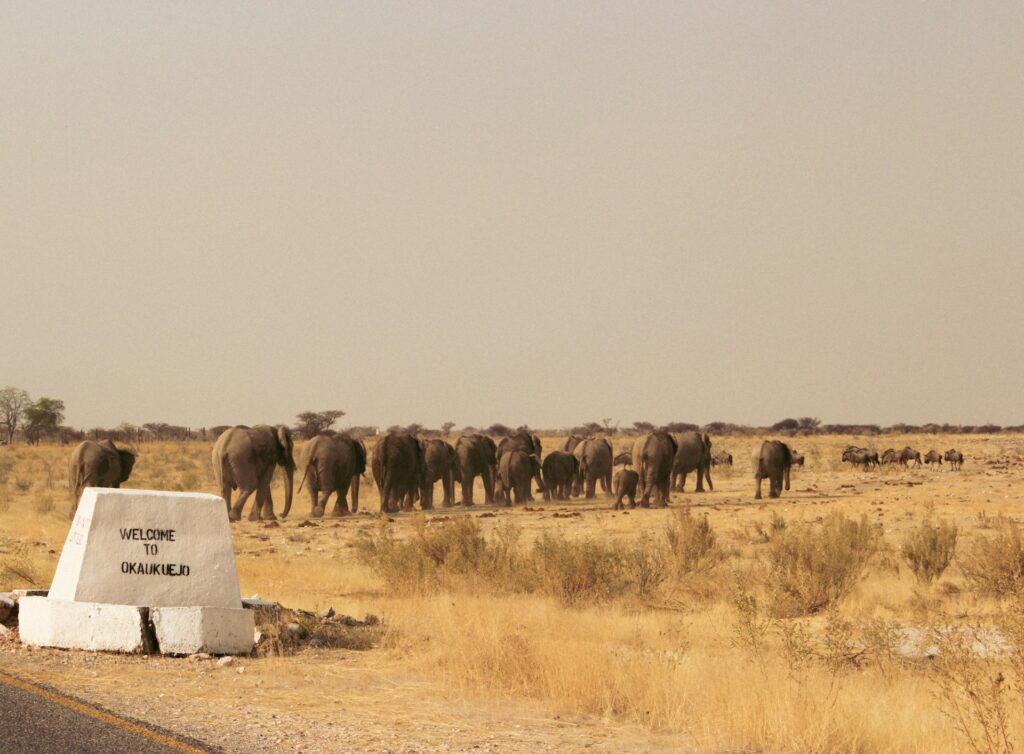
Although the area where you’ll have access to wildlife viewing in Etosha is far smaller than the Kruger, the salt pan changes everything. You’ll see animals from kilometres away, and sightings of a zebra line drifting across the parched white earth, or a single elephant appearing like a grey island on the horizon, are not uncommon.
On the map, Etosha is bigger, but since tourist areas are limited, it makes the space far smaller.
That means that in the comparison of Etosha vs Kruger, the Kruger is bigger.
While we’re on the subject, guests travelling to the Kruger also have the option of booking safaris in the Greater Kruger Park, a private conservation area that runs down the left side of the park, and consists of some of Africa’s most iconic and luxurious destinations, like Timbavati and Sabi Sands.

Can you see the Big Five at Etosha?
If you are basing your Etosha vs Kruger choice entirely on seeing the Big 5, then you only have one option, and that is the Kruger.
Etosha National Park, while home desert-adapted wildlife, is home to only four of the Big Five – elephants, lions, rhinos, and the famously temperamental leopard, though leopards are not often spotted because they are the ultimate hide-and-seek champions.
The one missing Big 5 member is the Cape Buffalo. You won’t find them here.
The Kruger on the other hand is home to all of the Big 5 and what’s more is that due to the park’s abundance of wildlife, you could very well see them all in just one morning game drive (although, its best to not get your hopes up to see them all in one go, because the wildlife sightings happen naturally rather than on demand).
So, if you’re deeply set on ticking off the Big Five, go to the Kruger National Park.
But if you are happy with seeing 4 out of the 5 and if your heart yearns for open spaces, shimmering pan scenes, and hour-long sightings, all to yourself, of elephants wandering across pale landscapes at their own unhurried pace, then Etosha safaris become incredibly tempting.
When planning your safari in Etosha vs Kruger, keep in mind that aside from the Big 5, there are plenty of other animals that you’ll enjoy seeing.
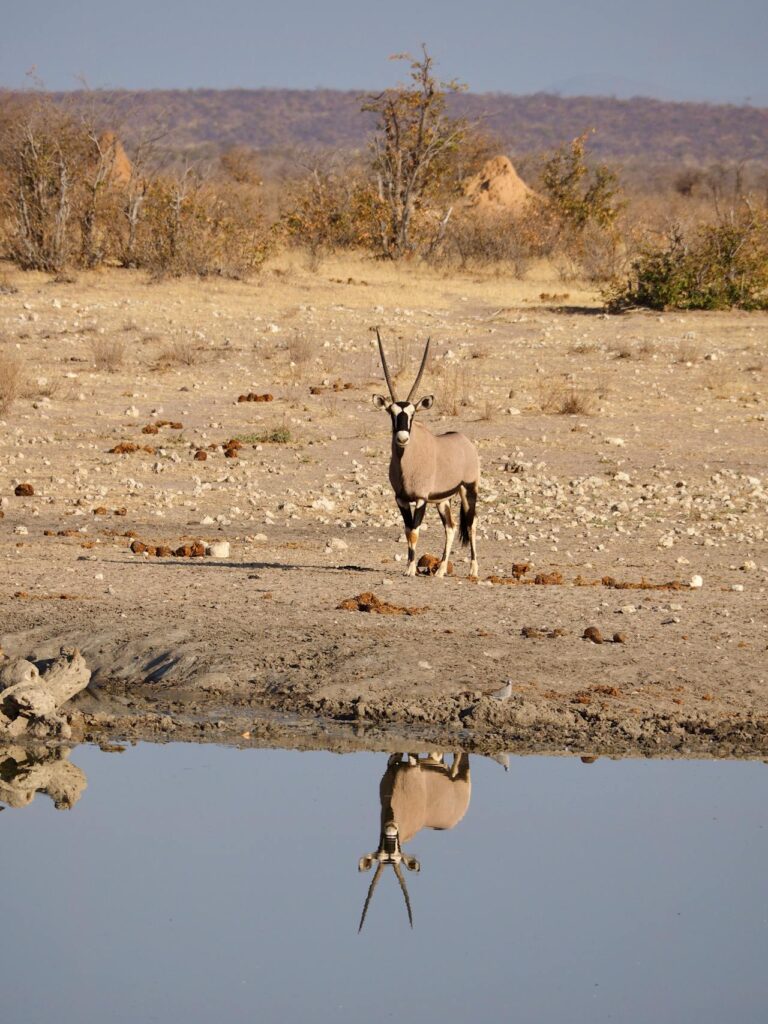
Etosha has 114 mammal species, 340 bird species, 110 reptile species, 16 amphibian species and 1 just one species of fish (which is understandable given the park’s often dry climate). Some of the more interesting animals you can spot here are black-faced impala, springbok, oryx (or gemsbok as they are called in Namibia and which just happen to be Namibia’s national animal) and black rhino.
The Kruger is home to 147 mammal species, over 500 bird species, 114 reptile species, 49 fish species, and 34 amphibian species. Along with seeing a range of antelope, like kudu, nyala, duiker, and bushbuck, you’re also likely to see giraffe, hippo, crocodile, jackal, eland and more.
Regardless of the park, Etosha vs Kruger, that you choose, you won’t be disappointed by the sights you see.

What is the nearest airport to Etosha?
If you’re heading to Etosha National Park, your gateway will almost always be Hosea Kutako International Airport in Windhoek.
Windhoek’s airport is calm, easy to navigate, and a friendly starting point for Namibia safaris. You’ll experience simple arrivals, warm smiles, and refreshing desert air that hits you as soon as the plane door opens.
From the airport, it’s a 7-and-a-half-hour drive or a shorter charter hop if you prefer to sit back and watch Namibia’s textures unravel below you.
Most travellers prefer to drive to Etosha from Windhoek, making it an exciting part of the safari experience.
The roads between the two destinations will give you plenty to see.
Some of the sights on your drive include Spitzkoppe, the Dinosaur Tracks Guestfarm, where you’ll see real dinosaur tracks from different species, Waterberg National Park, Hoba Meteorite, Tsumeb Museum, and Gross Barmen.
Is Etosha worth visiting?
Absolutely, and not in an off-handed “sure, why not” kind of way.
Etosha is completely one of a kind, where else can you travel through the desert and see a variety of wildlife?
It is a destination that can quite easily slip under your skin and become one of your most favourite safari spots, especially if you are looking for a place that the rest of the travel world has not yet found, at least, not in the way they have found the Kruger.
There’s something about the stillness of the pan, the long silvery horizons, and the way waterholes become natural theatres that make it such a special place, one worth visiting.
You can park your car and settle in close to a waterhole, and suddenly realise that hours have passed by while you’ve watched elephants wander in, lions lurk at the edges, and springbok flicker by in a blur.
The whole experience is one that feels almost surreal.
Etosha is worth visiting if what you want from a safari is space, quiet, and a mood that is completely unlike that of traditional routes.
And if you’ve been dreaming about safaris in Namibia specifically, Etosha is your grounding point, the place where it all begins to make sense.
Are Namibia and South Africa neighbours?
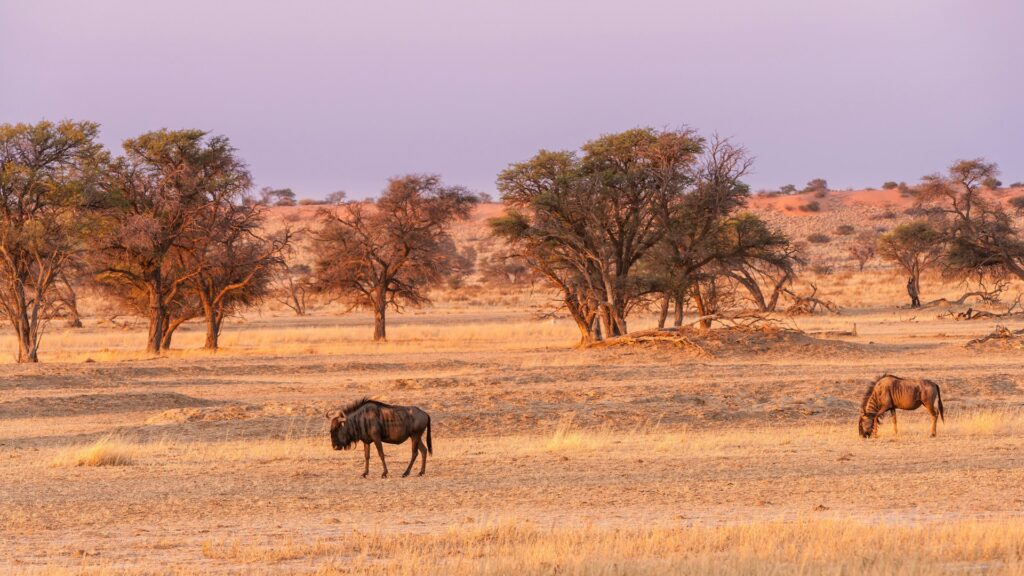
Yes, and they share a long border, as well as the Kalahari Desert.
And because of that, comparing Etosha vs Kruger is completely natural. Both parks sit within southern Africa’s safari belt, but they couldn’t be more different.
South Africa carries you into thick bushveld and winding rivers, where you’ll listen to bird calls, see an abundance of wildlife and enjoy that deliciously familiar hum of the Kruger lifestyle.
On the other hand, Namibia pulls you into a world of open skies, pale light, and wide quietness that makes you feel like the earth finally has enough room to breathe.
Choosing between the two isn’t about who’s better. It’s about which one speaks your safari language.
Both destinations will give you an out-of-the-ordinary walk on the wild side.
If you wish to travel to a place where, within its massive protected expanse, you can see an abundance of wildlife, stay in luxury lodgings and visit historical and archaeological sites, then pick the Kruger.
But if you want an experience that is rare among travellers, and will give you a slower pace, with plenty to see but fewer crowds to contend with, then pick Etosha.
Yes, especially if you’re drawn to open landscapes, if you want striking photography opportunities, and if you are looking for a slower safari style, where you can spend hours at a time in one spot, seeing a variety of animals.
For first-time travellers looking at Etosha vs Kruger, the Kruger National Park is usually the go-to option, because the park is easily accessible and it always delivers spectacular sightings, something newcomers to Africa will appreciate. For a first safari, the Kruger is also a preferred destination, because it is well-known for its big game sightings. Etosha, on the other hand, is a more laid-back, slow safari experience, and the sightings don’t come as readily as they do in the Kruger.
You’ll see four of the five. Buffalo are not present in Etosha. If you are looking at Etosha vs Kruger based solely on Big 5 sightings, head to Kruger.
June to October are the best months to visit Etosha for the best wildlife viewing. This is the park’s dry winter season, and with the lack of water, animals will congregate around the few water sources left. November to March, the park’s green months, are a great time to visit if you want colourful bushveld, dramatic skies, and quieter lodges.
Many say the dunes of Sossusvlei; others argue for Damaraland. But Etosha’s pan at sunset? It’s in a league of its own.
