

Few places in Africa have a simple, straightforward history. Much like the rest of Africa, Namibia has a history before colonisation and a history after.
For many years, outsiders mistakenly believed that Namibia history started with the colonists and that it was a nation with little knowledge of its precolonial past simply because much of it was not written down.
But history does not only live in books.
In Namibia, history lives in the rock art, in the carefully preserved oral traditions, and in the stories that have been passed down through generations, by cultures such as the Himba and the Herero.
As such, Namibia history is rich, layered, and complex.
When you begin to peel back those layers, exploring its cultures, its sometimes brutal conflicts, and its glorious victories, you soon see a proud nation that has been forged through endurance and moulded by an inspiring, unbreakable spirit.
To truly appreciate your time in Namibia, you should start by learning as much as you can about its history. And in this guide, we’ll be sharing all you need to know.
When was Namibia Discovered?
Namibia was never discovered, at least not in a traditional sense.
When people talk about Namibia being discovered, they are generally asking when the first Europeans set foot on the country’s shores.
Long before any foreign ship appeared through the dense fog on the cold Atlantic horizon, communities such as the San were living, hunting and painting stories onto rock faces across what is now Damaraland and the Brandberg.
Archaeological evidence suggests human presence for tens of thousands of years, making the early chapters of Namibia history among the oldest on earth.
And this ties in well with the fact that Sub-Saharan Africa is considered the birthplace of humanity.
Some of the earliest evidence of human life on earth comes from nearby South Africa and the Zambezi River area in Botswana. It is then believed that humans migrated out of the area, travelling north and eventually settling in Asia, Europe and the rest of the world.
The first recorded European contact in Namibia history came in 1486, when the Portuguese navigator Diogo Cão reached the Skeleton Coast and erected a stone cross near Cape Cross.
But he and his fellow early adventurers did not travel inland at all.
In fact, for centuries after Diogo Cão walked the Skeleton Coast, much of the interior of the country remained unknown to outsiders.
When you walk the dunes, or explore the Fish River Canyon, or when you run your hand along the rock art, you are quite literally feeling the history of the country.
Few experiences are as humbling or as awe-inspiring as standing on the ancient sands where generations before us walked; the very people whose resilience and vision helped shape the Namibia we know and love today.

Was Namibia colonised and by whom?
Like most Southern African countries, Namibia was once colonised, and that period of the country’s history is complex and sobering.
In 1884, Germany declared the territory a protectorate known as German South West Africa.
Colonial rule completely restructured land ownership, infrastructure and social hierarchies.
The early twentieth century saw the horrific genocide of the Herero and Nama peoples between 1904 and 1908, in an event that is now widely recognised as one of the first genocides of the twentieth century.
After Germany’s defeat in the First World War, South Africa took administrative control under a League of Nations mandate.
While under South African rule, Apartheid policies were imposed in 1948, under the Nationalist Party government, further drastically affecting Namibia history and its social fabric.
Namibia finally gained independence on 21 March 1990, a date still celebrated with great pride.
To learn more about this period of Namibia’s history, you should spend some of your time at the Independence Memorial Museum in Windhoek.
You can also visit the National Museum of Namibia, Namibia’s oldest museum.
What Did Namibia Used to be Known as?
Names matter in Namibia history, and the country has had a few.
During German rule, the country was called German South West Africa.
Under South African administration, it became simply South West Africa.
The name Namibia was adopted at independence.
As you can more than likely tell, the name is derived from the Namib Desert, one of the world’s oldest deserts and also the country’s defining geographical feature.
The evolution of names explains the Bavarian architecture in Lüderitz, the German street names in Swakopmund, and the Afrikaans influences still heard in conversation.
Namibia history continues to live on, although quietly, in these details, helping to mould the country’s aesthetic and contributing to the atmosphere of the towns you may pass through on your guided Namibia tour.

Who are the indigenous people of Namibia?
Although the past has been defined by many events and people, Namibia history really begins with its indigenous communities.
Each community adds to Namibia history through their language, music, ceremonies and passionate stewardship of the land.
The San, often referred to as Bushmen, are one of the oldest continuous cultures on the planet. The San people once lived in areas throughout Southern Africa, but today their descendants mostly live in South Africa, continuing a way of life few understand or appreciate.
The Nama and Damara also have deep roots here, as do the Herero, who are recognisable for their distinctive Victorian-inspired dress, a poignant reminder of colonial entanglements.
The Himba, who paint their bodies in protective mud called otjize, are among the best-known indigenous people of Namibia. Otjize is a mixture of ground-up red ochre-coloured stones and butterfat. The mixture protects their skin and is a cultural symbol of beauty.
In northern Namibia, the Ovambo people form the largest ethnic group, and they played a central role in the liberation struggle.
While in Namibia, you can meet some of these people through tours that have been arranged respectfully and with community benefit in mind.

What Language do they Speak in Namibia?
English is the official language, and it was adopted as the official language at independence to unify a multilingual nation.
However, Namibia history has left a rich linguistic web that includes a mixture of colonial and indigenous languages.
Afrikaans remains widely spoken, a legacy of South African rule, while German persists in business and daily life in certain towns.
Indigenous languages such as Oshiwambo, Khoekhoegowab and Otjiherero are also heard across the country.
But despite the various languages spoken in Namibia, they are rarely a barrier.
Guides are typically fluent in English and highly educated in Namibia history, which enables them to weave political context, geology and their own personal narrative into the experience you’ll have while travelling here.
Is Zulu Spoken in Namibia?
Zulu is not commonly spoken in Namibia.
It is one of South Africa’s major languages and does not form part of the linguistic foundation of Namibia history.
While you may occasionally encounter a Zulu speaker due to regional migration, it is not native to Namibia.

Is Namibia a Rich or Poor Country?
Namibia is classified as an upper-middle-income country by the World Bank, largely due to its mining sector, which includes diamonds and uranium.
Yet Namibia history has left deep economic inequalities, especially in terms of land ownership and rural development.
Windhoek and the coastal towns are known to have polished hotels, fine dining and contemporary art galleries but outside the city and posh towns, rural communities sometimes have limited access to services.
For discerning travellers, this contrast underscores the importance of responsible travel choices.
You should always go with tour operators who invest locally and understand Namibia history, to ensure that your trip contributes positively to the country’s ongoing story.
What is Namibia Well Known For?
Namibia is famed for its astounding landforms like the Namib Desert, the red dunes of Sossusvlei, the utter, desolate beauty of the Skeleton Coast and the wildlife-rich plains of Etosha National Park.
And many of the landscapes and some of the architecture have also contributed to the fame and history of the country.
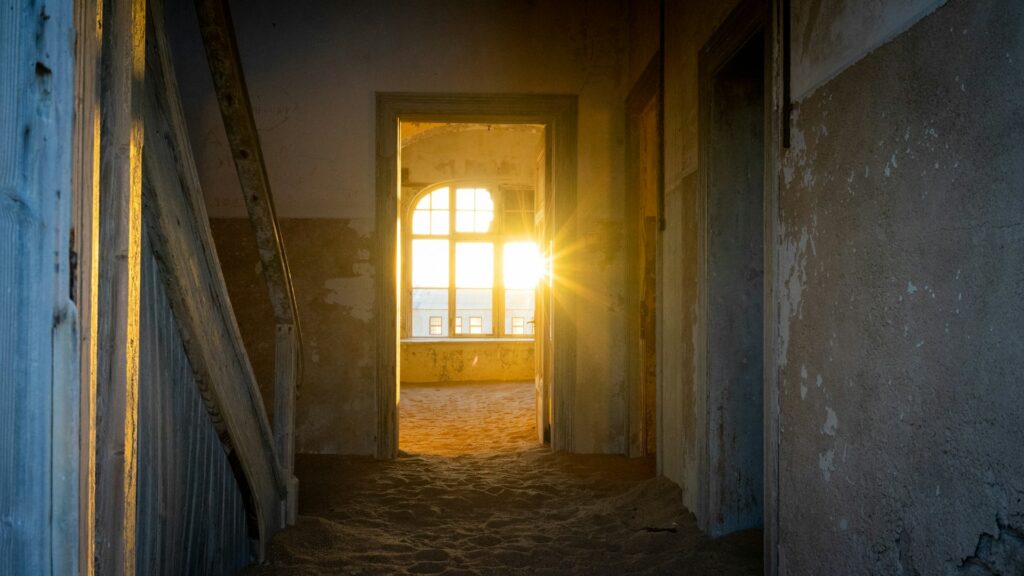
At Twyfelfontein, ancient rock engravings speak across millennia, and close to Lüderitz, the abandoned diamond town Kolmanskop stands half swallowed by sand, a haunting reminder of past colonial ambition.
In Windhoek, modern government buildings sit alongside German-era architecture, illustrating how Namibia history continues to play a role in the present.
Namibia is also well-known for catering to luxury travellers.
For those planning a luxury Namibia tour in 2026, the infrastructure is excellent, with high-end lodges, reliable charter flights and expertly trained guides. And the country’s reputation is also bolstered by being famously politically stable and widely regarded as one of Africa’s safest destinations.

Namibia is not just a place to photograph. It is a nation whose past can still be seen lingering just beneath the surface. To travel here without understanding what made this country great would be to miss half the experience.
If the history of Namibia has sparked your curiosity (or wanderlust), we’d love to help you plan your 2026 Namibia tour.
Namibia became independent from South African rule on 21 March 1990.
It was known as South West Africa during German colonial rule and later under South African administration.
Yes, Apartheid was implemented in Namibia from 1948 to independence.
Yes. English is the official language and is widely used in government, business and tourism.
The country’s history has been determined by its architecture, languages, cultural traditions and even land ownership, adding depth to every curated journey.
