

The Sossusvlei area of Namibia is easily one of the most beautiful places in all of Africa, and one of the best ways to explore the region is to book a guided Sossusvlei tour. But before you click on a book now button, read this guide that covers everything from where to find it on the map to how to time your visit, what to look for, and why it has earned a permanent place on Namibia travel itineraries.
*
Arriving just in time to watch the sun set, I trudged my way along the sands and began the climb to the top of Big Daddy Dune.
The area is covered in dunes, but Big Daddy lives up to his name and towers above me, as I slowly but determinedly make my way to the top.
The wind is blowing, and the sand is getting everywhere. The sun sets slowly in this part of Namibia, but the climb is a challenge, and I really want to see the view and get back down again before the light disappears.
After 50 minutes, I finally get to the top. It’s winter, and the light is especially magnificent. The sun is starting to go down, and I am in my element, snapping as many photos as the fading light will allow me.
It’s truly something awe-inspiring to stand where I am.
This particular part of the Namib Desert is between 55 and 80 million years old, but the dune itself, as well as the sands that make up Sossusvlei, are always in motion. It’s a paradox of sorts. I am standing on the oldest sands on the planet, but on a dune that is newly formed or at least changed, year after year.
There’s a metaphor here, but I’ll let you reflect on the feeling later, when you are on your own Sossusvlei tour.
Sossusvlei is a timeless addition to the Namibia travel itinerary. You’ll see it mentioned in blogs, guides, must-see lists and best of rankings.
When I reached the summit, I realised exactly why this is a phenomenal spot. To fully make the most of your time here, you need to know the ins and outs of this ancient place.
Where is Sossusvlei?
Sossusvlei sits within the Namib-Naukluft National Park in western Namibia, roughly 350 kilometres from Windhoek via the C24 and D854 roads.
The name itself is a mix of the Afrikaans and Nama words for “dead-end marsh,” a reference to the clay pan in the valley that occasionally, after significant rainfall, fills with water. This happens rarely enough that seeing it in action counts as something close to having the absolute best luck.
The few plants that you’ll come across here are kept alive by the fog that occasionally drifts in from the Atlantic, and most of the wildlife has become desert-adapted.
The wider region falls within the Namib Desert, which is widely regarded as one of the oldest deserts on earth, with an estimated age of 55 to 80 million years.
Its dunes are not static, although, when standing at the top, I found it hard to imagine that they shift, stack, and reshape themselves under the influence of wind, becoming some of the tallest sand formations on the planet.
The slow shape-shifting sands really make you think about the passage of time. We don’t notice time passing in nature, but to the earth, a million years pass in the blink of an eye.
What Will You See in Sossusvlei?
The dunes are the most obvious attraction.
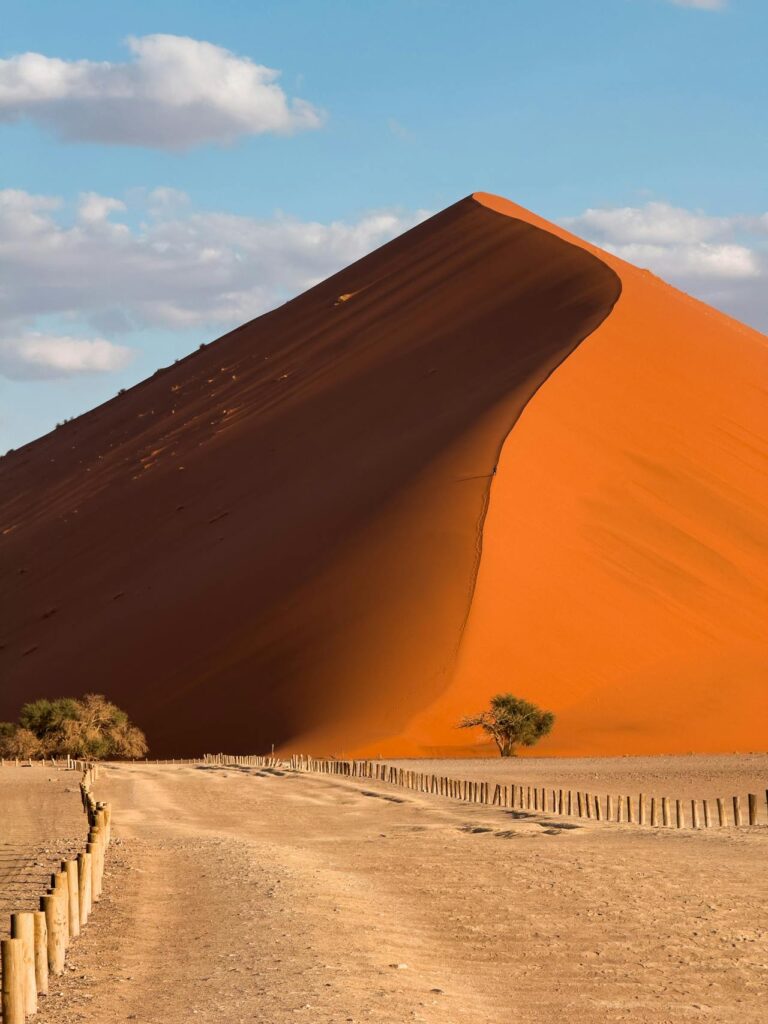
Big Daddy (also known as Dune 7 in some maps) is the most famous. It rises to around 325 metres, and it will give you the finest view across the white clay pan of Sossusvlei and the neighbouring pan of Deadvlei. It is worth the effort, and while in some conditions it can be a tough walk, for most, the walk is rather easy, especially if you take your time.
Aside from Big Daddy, the other popular dune is Dune 45, so named because it stands 45 kilometres from Sesriem along the main road, and is one of the most photographed in Namibia. At approximately 170 metres high, it is climbable, though the ascent is more of a negotiation with gravity than a leisurely stroll, making it the harder option.
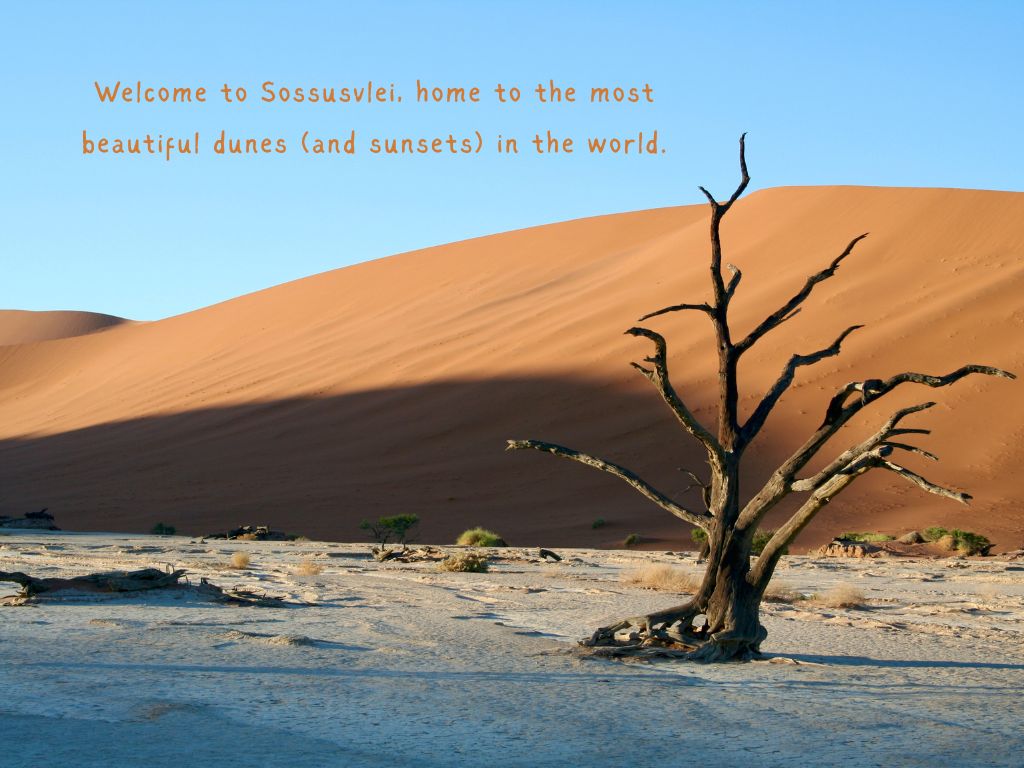
Sossusvlei is also home to Deadvlei, which is perhaps the single most arresting scene in the entire park.
Deadvlei is characterised by a cracked white clay floor scattered with the skeletal and fossilised remains of camel thorn trees, some estimated to be 900 years old, set against rust-burnt orange dunes.
The trees died when the watercourse shifted centuries ago, but because the air is so dry, they never decomposed. They simply stayed preserved and beautiful, and today they are one of the most photographed scenes in Namibia.
I spent a good hour or two walking around Deadvlei. You have to walk around a kilometre from the parking area to get to this preserved piece of land, but I promise, it is worth it.

The Flora and Fauna of Sossusvlei
Sossusvlei is in one of the driest parts of the Namib, but it is not all sand and no foliage. The vegetation is sparse, yes, but it’s there, and it has a purpose.
The camel thorn acacia (Vachellia erioloba) is the most iconic tree you’ll see while exploring here, a species capable of surviving on almost nothing. It provides a little shade for the critters and creatures that need a break from the heat.
Nara melons, with their thick, spiky skins, can be seen pushing through the sand and provide both moisture and nourishment for the creatures that find them.
The area also has a few animals, like the Oryx (gemsbok), which can on occasion be seen moving through the dunes with a kind of unhurried authority. Their ability to regulate body temperature in extreme heat makes them uniquely suited to living in the desert, and a sighting against the dunes at golden hour is a cherry on top moment.
Springbok, ostrich, and brown hyena are also present and often seen on a Sossusvlei tour, and those who’ve come to see birds will enjoy spotting Namaqua sandgrouse, dune larks, and grey-backed sparrow-larks.
How To Get There
The closest town with both comfortable and luxurious accommodation and fuel is Sesriem, which sits at the main entrance gate of Namib-Naukluft National Park.
Most visitors will fly into Windhoek’s Hosea Kutako International Airport and drive south-west to the park. The road trip takes approximately four to five hours on reasonably surfaced roads, though a 4×4 or high-clearance vehicle is strongly recommended for the final stretch to the dune car park. A 2×2 vehicle will not be able to take you to the dunes; the road is just enough to leave those cars struggling.
You won’t be able to just set out on a Sossusvlei tour at just any time. You’ll have to wait for the park gates to open.
To get the best lighting (and the best temperatures), you will want to head to the gate one hour before sunrise, and then after that you’ll follow the 60-kilometre route to the pan. The road is paved as far as the main parking area.
A shuttle service operates from the car park to Deadvlei for those who prefer not to walk the additional five kilometres in the heat.

Tips For Planning a Sossusvlei Tour
And now for the nitty-gritty part of your Sossusvlei tour planning, the tips you need for getting everything just right.
Go early. The first hour of light is the reason photographers plan their entire Namibia trip around their visit to Sossusvlei. The dune colours change from pale gold through amber to deep rust as the sun rises, and the shadows are long and theatrical.
Stay inside the park if your budget allows. Sossusvlei Lodge and Little Kulala both sit within or adjacent to the park boundary, meaning you access the gate before it opens to outside visitors. That head start is going to matter enormously if you are travelling during the busy high season.
Bring more water than you think you need. This is a genuine desert. The temperatures in summer can exceed 45°C in direct sunlight, and you’ll easily drink a litre of water per hour when you are walking around here. There’s also not a single shop near the dunes, so it’s best to be as prepared as you possibly can be.
Visit in the cooler months. May through August will give you the most comfortable conditions. June and July mornings can be surprisingly cold at the dune base before the sun takes hold. Travelling during the Namibian winter months will allow you to spend a lot more time enjoying the sights and sounds of the great outdoors.
Give Deadvlei its own time. Many visitors arrive in the late morning when the crowds are at their thickest, and this can ruin the experience if you want solitude or if you just aren’t the biggest fan of crowds. I visited in the late afternoon, when the dune shadows fall long across the white pan, and I had an entirely different experience. Fellow travellers were few and far between, and I didn’t feel as though I had to rush to give someone else a chance to enjoy the scene.

PLAN YOUR SOSSUSVLEI TOUR WITH NAMIBIA SAFARIS
A full-day visit allows time for Dune 45, Big Daddy, and Deadvlei comfortably. Most guided Sossusvlei tours run from sunrise to early afternoon, covering all major sites within five to six hours. Staying overnight in Sesriem or within the park enables a sunrise start without rushing.
May through August is widely considered the best time for a Sossusvlei tour. Temperatures are cooler, mornings are crisp, and the dunes photograph beautifully in the lower winter sun. Summer (November to February) is possible but extremely hot, with midday temperatures regularly exceeding 40°C.
The main road from Sesriem is paved, so a standard vehicle can reach the primary parking area without difficulty. However, the last section to the Sossusvlei pan itself is soft sand, and a 4×4 is required for that stretch. A park shuttle operates for visitors without 4×4 vehicles.
It is a natural anchor for any Namibia tour. Combining Sossusvlei with Etosha National Park, the Skeleton Coast, and the Fish River Canyon gives a rounded picture of the country’s extraordinary geography. Many Namibia safari itineraries are structured around a three-to-four-week loop that includes all four.
Yes, and it is encouraged. Dune 45 is the most popular climb and accessible to most fitness levels. Big Daddy is steeper and more demanding, but you’ll be treated to sweeping views over Deadvlei. Climbing is best done in the early morning before the sand heats up and the summit wind picks up.
