

As one of the world’s most exciting places to travel, Namibia has earned a reputation for its stunning attractions, its numerous adventure activities, and its ability to give travellers a couple of options for how they can see the country.
It is one of only a few countries where both fly-in and self-drive experiences can be done properly, and when you are in the planning phase of your tour, you need to give some careful thought to how you’d like to make your way around.
Covering more than 825 000 square kilometres, Namibia is large enough that distance itself is a hugely important part of the planning, and every itinerary eventually comes back to the same question: do we want the road, or the sky?

Self-Drive Tours in Namibia
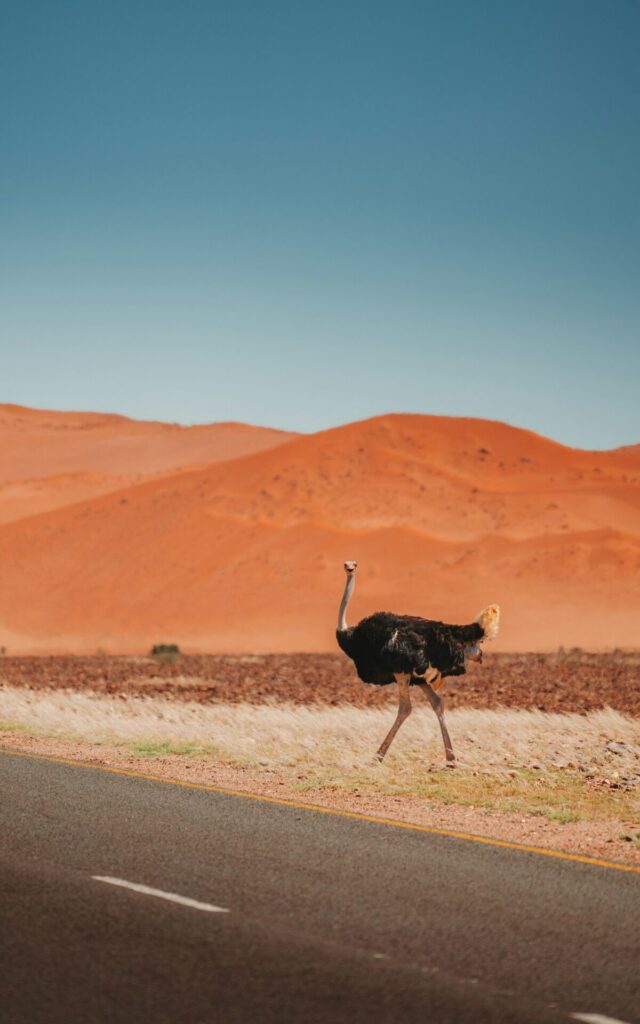
Pulling out of Windhoek’s Hosea Kutako International Airport in a loaded 4×4, with the city falling away behind you within minutes and the open gravel road stretching ahead, is the stuff that every great road trip is made of.
Namibia is one of the few countries in the world where the journey carries as much weight as the destination, giving new meaning to the old idea that getting there is half the pleasure.
The real question is whether you have the time, and the temperament, to let the open road become a defining part of your holiday.
What to Expect from Namibia’s Roads
If you are worried about potholes or some other lack of maintenance, don’t be.
Namibia has one of the best-maintained road networks in sub-Saharan Africa.
Roughly 5 700 kilometres of the national road network are tarred, connecting Windhoek to major towns including Swakopmund, Lüderitz and the northern gateway to Etosha.
The gravel roads are also taken care of, well graded and clearly signposted, though you do have to slow down a lot while on these stretches, for the good of your vehicle and for safety reasons (most of these roads are very remote and help can be far away).
A road that looks like a 200-kilometre afternoon drive on a map can easily take a full day once the corrugations, the photo stops and the oryx crossings are factored in.
Namibia has one of the lowest population densities anywhere on earth, with only around three or four people for every square kilometre. Outside of Windhoek, it is entirely possible to drive for an hour and pass nobody at all, which is why many travellers say that driving through Namibia can leave you with the impression that you are the only person left on the planet.
A 4×4 is recommended for most itineraries, not because the roads are treacherous, but because higher clearance and proper tyres make a huge difference for both comfort and safety on long gravel stretches.
Driving at night is strongly discouraged across the country, since wildlife move around quite a lot after dark and the roads have no lighting whatsoever.
The rule of thumb is simple: be parked and settled well before the light starts to fade.
The Great Things About Road Tripping
A self-drive tour will give you total control over your pace and itinerary, the freedom to stay a while longer at interesting spots, or follow an unplanned detour toward a rockface that looks especially photogenic, catching the last of the afternoon light.
You’ll have the widest open spaces; you’ll see pretty much no one else between destinations, and the slow accumulation of small, unscripted experiences is usually what road trippers remember and romanticise most when they return home.
The costs involved are also a lot more appealing and can give you some flexibility with your budget.
Self-drive accommodation is typically priced without the fully inclusive structure of fly-in tours, which means you can organise your budget more precisely.
Park fees are paid directly at the gate, and meals and drinks are chosen rather than bundled in.
What You Need to Plan for if You Are Road Tripping
Namibia is a large country; it’s massive, and covering it by road takes time.
If you try to pack too many destinations into too few days, you’ll end up being on the road more than you are enjoying the sights.
The distance from Windhoek to Sossusvlei alone is roughly 360 kilometres, mostly on gravel, and that’s a full day’s drive that many travellers underestimate.
And when you add Etosha, Damaraland, the Skeleton Coast and a couple of dunes, the driving hours accumulate quickly.
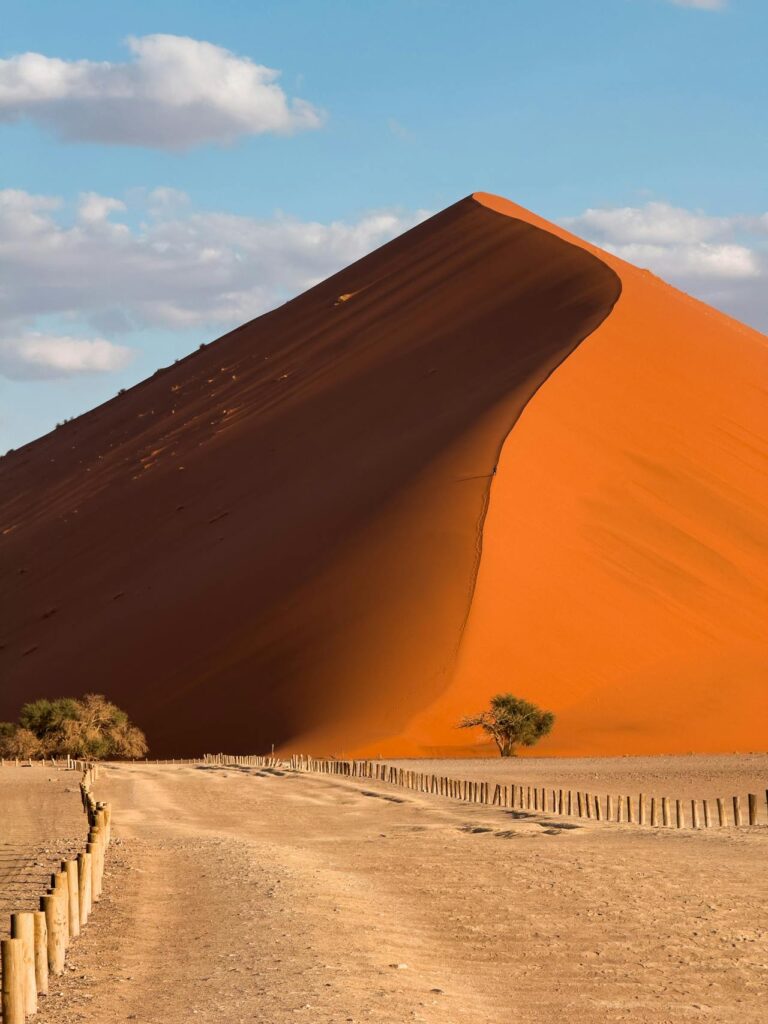
The dune most travellers come to see, Big Daddy at Sossusvlei, rises around 325 metres above the desert floor, making it one of the tallest dunes anywhere in the world. Climbing it takes most people the better part of an hour, though the run back down through soft sand takes only a few glorious minutes.
The dry season, from May through October, is generally considered the best time for a self-drive safari in Namibia.
Roads are firm, wildlife gathers around shrinking water sources, and the skies stay clear.
The green season from November to April is also a great time to travel by road, and you’ll see dramatic skies and newborn animals, though some gravel roads can become temporarily impassable after heavy rain. Still, such rainfall is rare.

Fly-In Tours in Namibia
A fly-in safari is exactly what it sounds like.
Guests travel between destinations by light aircraft rather than by road, landing on private or community airstrips that place them within minutes of a lodge or wildlife area.
In a country of Namibia’s size, where some of the most stunning landscapes sit hundreds of kilometres apart, flying gives you more time to see more parts of the country.
What To Expect from a Fly-In Tour
Most fly-in itineraries operate through a network of scheduled or charter light aircraft routes, with Windhoek’s Eros Airport serving as the usual departure hub.
From there, you can reach Sossusvlei, Swakopmund, Damaraland, the Skeleton Coast and the Caprivi Strip on flights ranging from 30 minutes to just over 2 hours.
The aircraft are small, typically carrying between five and ten passengers, and the view on descent alone will justify the ticket.
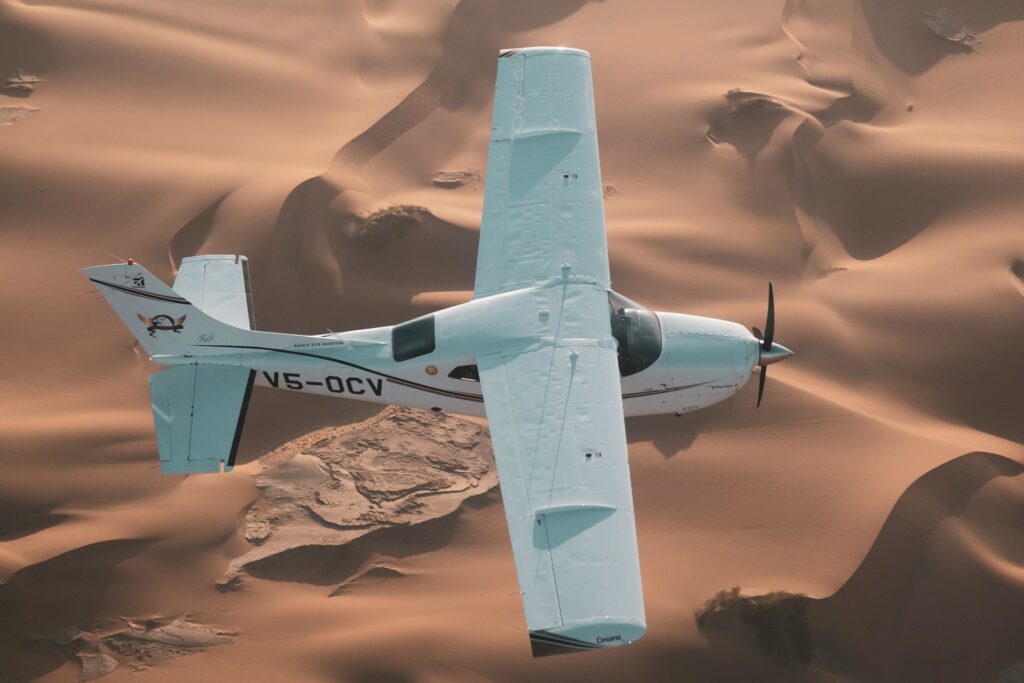
The Namib, the desert most of these flights pass over, is widely considered the oldest desert on earth, with an estimated age of somewhere between 55 and 80 million years. From the air, its dune fields look almost like a living sculpture, shifting slightly with every wind.
A minimum of seven days is generally recommended for a fly-in tour, enough time to settle properly into each destination rather than simply passing through.
Fly-in safaris are the ultimate luxury travel option.
Most fly-in packages are priced on a fully inclusive basis, which covers meals, local drinks, scheduled activities and park fees, which makes comparing the two ways of travelling on cost alone rather more complicated than you’d think, because it can quite literally be like comparing apples with oranges.
When Flying is Clearly the Better Choice
For travellers with limited time, the fly-in tour is ideal.
Flying from Sossusvlei to Swakopmund takes roughly 45 minutes by air while that same trip by road takes the better part of a day. That saved time can be better spent exploring.
The Skeleton Coast and the remote northern regions of Namibia, including Kaokoland and parts of Damaraland, are particularly well suited to fly-in access. Some lodges in these areas are really difficult to reach by road without plenty of driving experience and a well-equipped vehicle.
The Skeleton Coast is one of Namibia’s most interesting attractions. Early Portuguese sailors called it the Gates of Hell, and the shoreline is still scattered with whale bones, seal colonies and the rusting remains of ships caught out by thick coastal fog and treacherous currents. Seeing it from above can be absolutely haunting.
Fly-in tours are also the perfect option for travellers who want a tour with a little more structure.
Most fly-in packages are designed around morning and afternoon activities led by specialist guides, with the landscape, wildlife and the pace all managed on the traveller’s behalf.
If you are the sort of traveller who simply wants to arrive, enjoy the full experience, and leave the logistics to someone else, this is the way to go.
Namibia’s weather also works in favour of fly-in travel, regardless of the time of year you make your booking.
The country receives well over 300 days of sunshine every year, and flight conditions stay stable throughout the dry season.
The summer months, particularly January and February, can have the occasional afternoon thunderstorms, mostly in the interior, but these rarely cause lasting disruption to flight schedules.
How to Know If You Are Making the Right Choice
The choice between a self-drive and a fly-in tour basically comes down to what kind of memories you want to take home with you.
Road tripping through Namibia is slower, and that can make it more personal, with just you, the open road and all sorts of fascinating attractions, while flying connects you to the country’s highlights a lot faster and gives you more time on the ground at each destination.
First-time visitors to Africa who want a well-supported introduction often lean toward fly-in, since the logistics are handled and the days are perfectly planned.
Honeymooners and travellers who are celebrating a milestone choose it too, for the same reasons, as well as for the romance of watching the desert from above.
Photographers and travellers who enjoy more than the destinations at the end of it tend to fall for the self-drive tour instead, along with families who want the flexibility to slow down, stop often and let a trip happen a little more naturally.
And sometimes, the best thing you can do, if you can’t make up your mind, is to mix the two.
A common approach is to fly into the southern section to cover Sossusvlei and the Namib efficiently, then collect a vehicle to drive through Damaraland and up to Etosha, where the gravel roads give you a real safari experience.
*
Namibia Safaris specialises in luxury tours of this ancient desert country. We have both fly-in and self-drive tours available, as well as guided experiences.
Namibia is widely regarded as one of the safest and most straightforward self-drive destinations in Africa. The roads are well maintained, clearly signposted, and traffic outside of Windhoek is minimal. Visitors should carry a physical map alongside any digital navigation, take note of fuel stop distances, and plan to be off the road before sunset. A thorough vehicle handover briefing from the rental company is standard practice and worth taking the time to complete properly.
For peak season travel between June and September, bookings at the more sought-after lodges should ideally be made six to twelve months in advance. Charter flights and fully inclusive lodge packages at remote destinations tend to fill earliest. Outside peak season, three to six months is generally sufficient, though popular properties in areas like the Skeleton Coast may still require early commitment.
Most light aircraft used in Namibia’s fly-in safari circuit carry a luggage limit of 20 kilograms per person, packed in a soft-sided bag rather than a hard case. Rigid luggage does not fit easily in the small cargo holds of bush aircraft. Most operators include this information in pre-departure documentation, and lodges are generally able to assist with laundering during longer stays.
Yes, and this is increasingly the format that experienced Namibia travellers request. A common approach is to fly into the southern dune regions around Sossusvlei and Swakopmund, then collect a vehicle and drive north through Damaraland into Etosha. This structure captures the visual drama of the Namib from the air while allowing the more gradual, ground-level experience of the central and northern regions.
The dry season from May through October is the most popular period for fly-in travel in Namibia. Wildlife is concentrated around water sources, vegetation is lower and visibility is clearer, and flight conditions are consistently stable. The shoulder months of April and November offer excellent conditions with fewer visitors. The green season from December through March brings lush landscapes and newborn animals, with the added visual reward of dramatic skies over the desert.
