
Its unusual name often gets confused with Australia, and while it is far from the biggest or most exciting town in Namibia, Aus is a regular feature on many itineraries, if only as a place where you can stop for a cold drink and a walk about to stretch your legs.
But stay for even one evening, and Aus stops being a stopover and starts being somewhere worth visiting.
With wild horses drinking from a trough a few kilometres away, the wind carrying a chill few expect to feel this far into the desert, and the low brick ruins east of town holding a hundred-year-old story most visitors never hear, Aus can be interesting and, in this guide, we’re sharing everything worth knowing before you go.
Where is Aus?
Aus sits high up, in a fold of granite hills at the eastern edge of the Namib, in Namibia’s Karas region, roughly two and a half hours’ drive from Keetmanshoop and a little over an hour from the beautiful coastal town of Lüderitz (which just happens to be one of the best places for seafood).
The B4, a good tar road, runs straight through the middle of it, following the same route the railway once took before the Namib sand made the final stretch to the coast too dangerous for trains.
At close to 1 400 metres above sea level, Aus stands well clear of the desert floor below it.
The air is thinner here, the light a lot sharper on the eyes, and on winter mornings the cold settles into the granite in a way that will make you completely forget you are in a hot desert country.
In fact, it gets so cold here that snow was recorded in 1963, an event still spoken about between the locals, and Aus regularly registers the coldest winter nights anywhere in Namibia.
Its name comes from the Khoekhoe word for a big snake, and is tied to a natural water spring once used by Nama hunter-gatherers long before any road or railway even existed.
The town itself is barely a town at all; it’s a fuel station, a hotel, a handful of houses.
But its position, precisely where the inland highlands give way to the coastal desert, makes it one of the more useful stops in southern Namibia, whichever direction you happen to be travelling in during your tour.
What is There to Do in Aus?
Aus, Namibia might be a barely there slow town, but there are enough things to do to fill a day or two.
- The wild horses at Garub
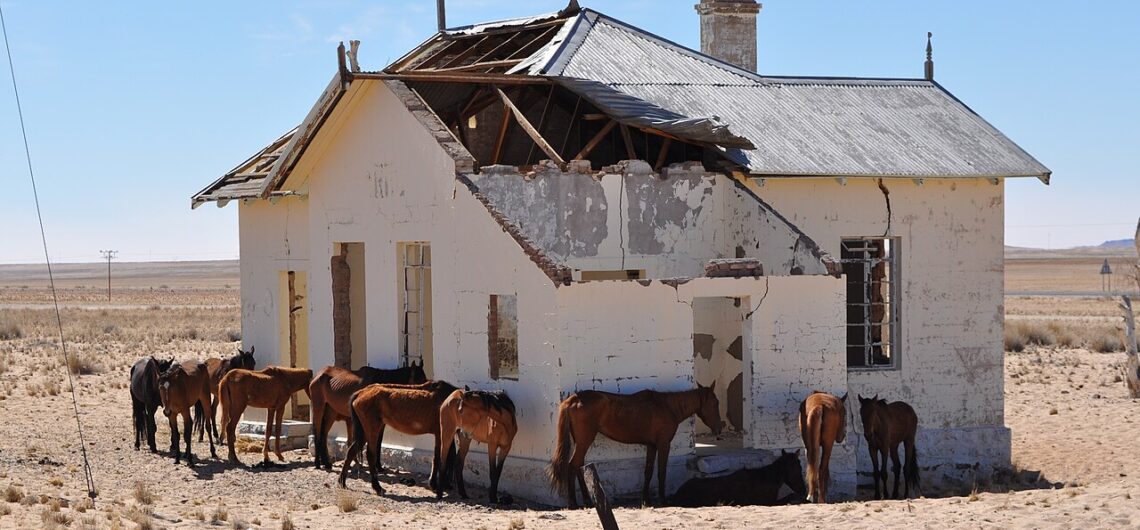
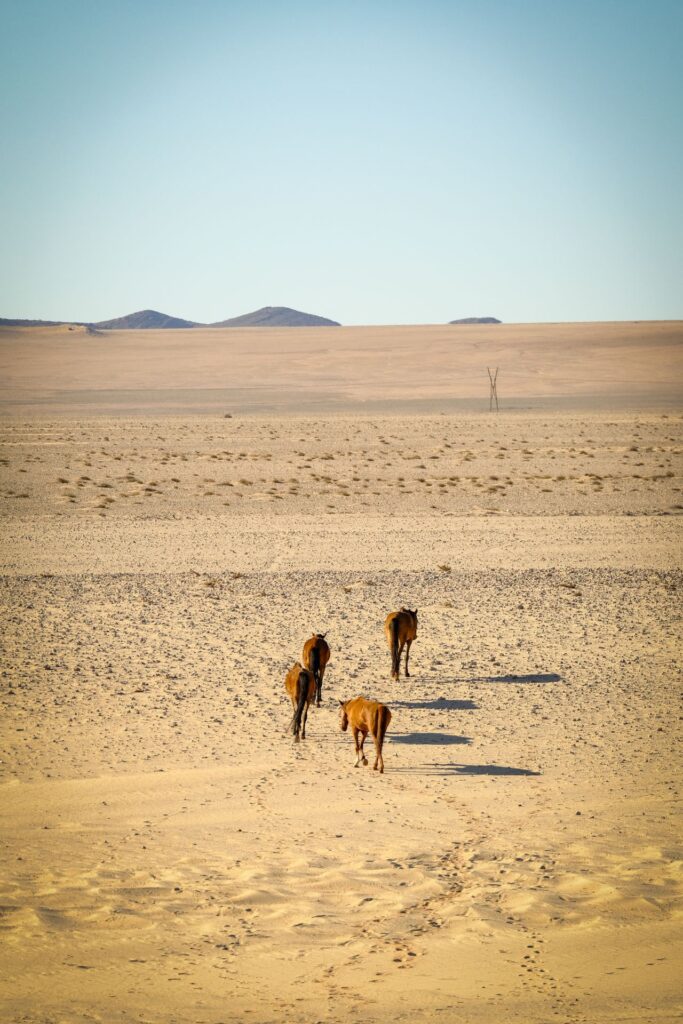
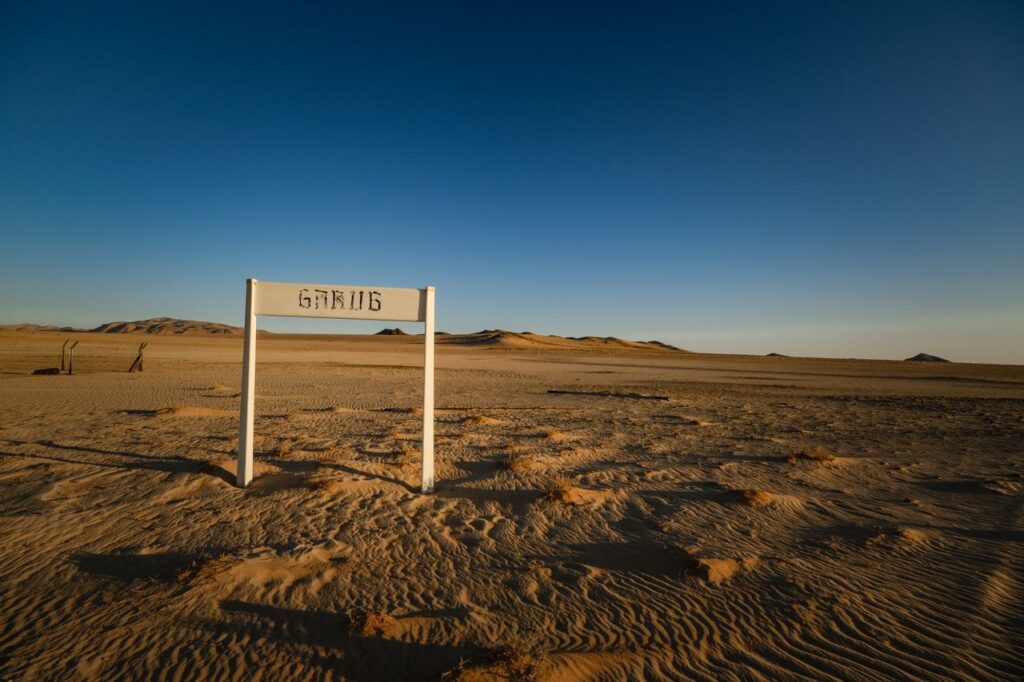
About twenty kilometres west of Aus, there is a simple hide that overlooks a waterhole where Namibia’s only population of feral horses come to drink.
Their exact origins are debated and include a stud farm at Kubub, cavalry horses from the German colonial forces, or both, but their resilience is not in question.
They have survived alone in one of the driest places on earth for more than a century and are a sight worth seeing.
- Walking and riding the Aus Mountains
The Klein Aus Vista lodge, just outside town, has several marked trails through granite boulders and camelthorn valleys that can be explored on foot, mountain bike or horseback.
Along the way sit the crumbling remains of First World War ramparts and, oddly, an old Hudson motor car, riddled with bullet holes from a long-forgotten shootout with diamond smugglers.
- The land art horse
On the plains below the lodge, a galloping horse the size of a football field has been set into the stone itself, a tribute to the animals that have made this area well-known.
- The prisoner of war camp ruins
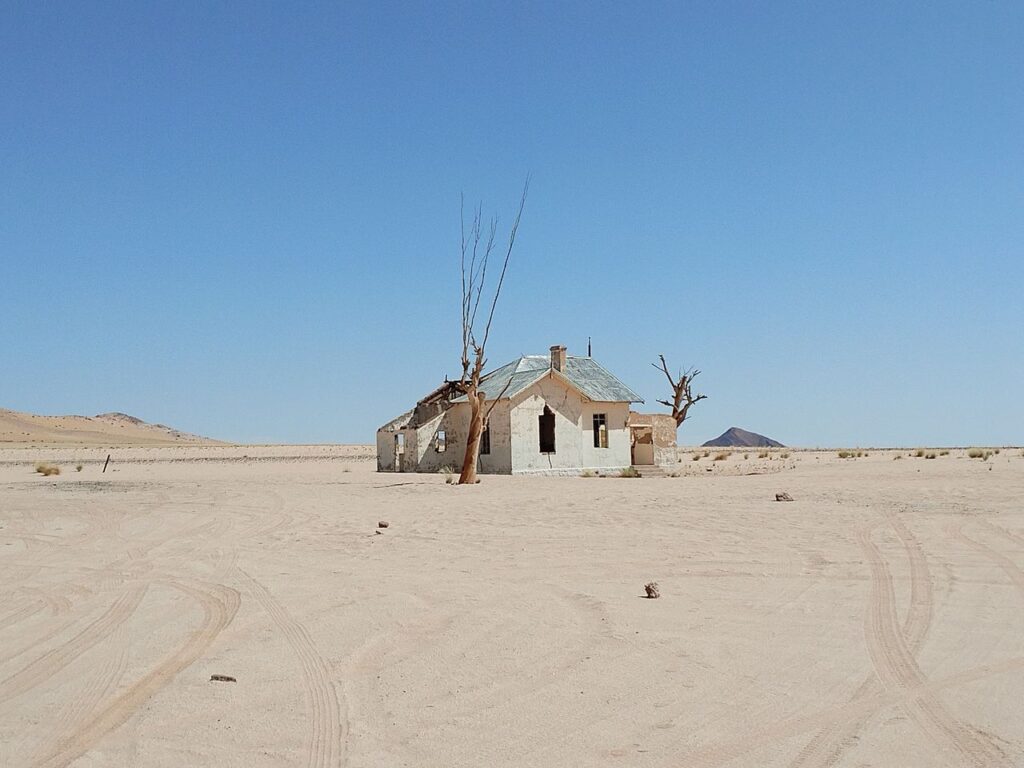
Five kilometres east of town, low brick walls and a small cemetery mark where more than a thousand German prisoners lived out the end of the First World War.
It is a sobering site, and worth the short detour, whether you are a history buff or not.
- Stargazing
With almost no light pollution and clear, dry air for most of the year, the night sky above Aus will give you one of the least interrupted views of the stars left on the continent.
As it is, Aus is not exactly a destination in its own right but rather more of a hinge on which a good southern Namibia itinerary swings.
Coming from Fish River Canyon or Keetmanshoop, it is the last proper stop before the road drops toward Lüderitz, Kolmanskop and the Atlantic.
Coming the other way, it is where the coastal fog finally lifts, and the light starts to look like you are back in the desert again.
Either way, a night here is a great way to break up a long drive.
What is the History of Aus?
Long before Aus appeared on any map, a natural spring here provided sustenance to the Nama communities moving through the region, which is where its name, which means big snake in Khoekhoe, comes from.
When Adolf Lüderitz began acquiring land along this coast in the 1880s, Aus fell within it, and a trading post slowly grew around the water source.
Sometime later, a railway line was built to connect the new coastal settlement with the interior, and it passed directly through Aus, some of it, uncomfortably so. The line was built using forced labour from the Shark Island camp near Lüderitz during what is known as a particularly grim chapter of the colonial period.
Aus’s most defining moment came in July 1915, after German colonial forces surrendered to Union troops from South Africa.
A prisoner of war camp was established just outside town to hold German non-commissioned officers, more than fifteen hundred of them at its peak.
What followed was unusual for the time.
Rather than simply enduring captivity, the prisoners built their own brick houses with floors sunk below ground level for insulation, laid out vegetable and flower gardens, formed a brass band, staged their own theatre productions, and even engineered a working clock loud enough to be heard a mile away.
Germans in the camp reportedly joked that in Aus, things really were finished, a pun on the town’s name that has outlasted the camp itself by more than a century.
The camp closed in 1919, its ruins declared a national monument in 1985, and Aus settled back into life as a small farming and trading post, sustained for decades by karakul sheep.
The horses that scattered during those war years, whether from the Kubub stud farm or army lines disrupted by the fighting, adapted to the desert around Garub and never really left.
In its own way, Aus has spent the last century being shaped by people and animals who arrived unplanned and chose, against the odds, to stay.
Timing Your Trip
Southern Namibia’s dry, cool months, roughly May to September, suit Aus best.
The days are clear and mild, the wild horses are easier to spot as sparse grazing draws them regularly to Garub, and driving conditions on the B4 are at their most pleasant and predictable.
You will want to pack for cold weather; it gets especially nippy after dark. Even in a desert town, winter nights can drop close to freezing, and more than one underprepared traveller has been caught out by it.
You will want to fuel up in Aus before continuing in either direction. Stations become scarce fast on the roads toward Lüderitz, Sesriem or Fish River Canyon, and this small town’s garage has saved plenty of self-drive itineraries from an awkward roadside wait.
Travelling Here Well
Aus asks very little of travellers.
If you stay on marked roads and trails, particularly near the Sperrgebiet boundary, where the old diamond restricted zone still protects a very fragile desert habitat, watch the horses from the hide rather than trying to approach them, and give the prisoner of war cemetery the same respect you would give any war grave, your trip will be very much fulfilling.
And none of this requires much planning on your part.
Most specialist Namibia itineraries already route through Aus as a matter of course, precisely because it sits at the point where the inland routes and the coastal ones naturally meet, and a good local operator will have already worked out the timing, the fuel stops and the right overnight stay long before you arrive.

Aus is a small town in Namibia’s ǁKaras region, about 230 kilometres west of Keetmanshoop and 125 kilometres east of the coastal town of Lüderitz, on the B4 road.
Most visitors self-drive along the tarred B4 road, roughly two and a half hours from Keetmanshoop or just over an hour from Lüderitz. Aus also lies on the route between Fish River Canyon and the coast, making it a natural overnight stop.
They are Africa’s only population of feral horses, living near the Garub waterhole 20 kilometres from Aus. Their ancestry likely combines German colonial stud and cavalry stock, and they have survived unaided in the desert for more than a century.
Yes, particularly as a stopover on a southern Namibia route. Aus combines wild horse viewing, First World War history, granite hiking trails and some of the darkest night skies in the country within a small, easily explored area.
May to September, Namibia’s dry winter season, brings the clearest skies, easiest driving conditions and best chances of spotting the wild horses at Garub. Nights are cold, so warm layers are essential even in this desert region.
