
There is a sound that visitors to Bwabwata mention before anything else when recounting the tales of their trip.
It is not the typical safari sounds, like the roar of a lion or the trumpet of an elephant, though both arrive soon enough, but of water.
Moving water, over stones, through reeds, past the roots of a jackalberry tree leaning into the current.
The local name for this place means the sound of bubbling water, and once you have heard it at dawn, you understand why nobody thought to call it anything else.
Most guides to Namibia rush past Bwabwata on the way to somewhere else, leaving it to become an awkward paragraph wedged briefly between Etosha and the Skeleton Coast.
That is a mistake, and rather a large one, because it would leave you to assume that this is not a park worth seeing.
But this place is unlike any other Namibian destination, one that is built entirely around two rivers, is home to some of the densest buffalo populations left on the continent, and is one of the last places in the country where wild dogs still run.
Bwabwata is an adventure destination, one that nomads and solo travellers will get a big kick out of and a place where there’s hardly ever another soul in sight for most of the day.
It is not a typical safari destination, and it hardly seems to belong in a country best known for its desert, but Bwabwata, when planned right, is an itinerary highlight.

Where is Bwabwata National Park Located?
Bwabwata sits in the far northeast of Namibia, in the narrow finger of land once known as the Caprivi Strip and now called the Zambezi region.
It is a strange piece of geography, a corridor barely forty kilometres wide stretched across nearly two hundred kilometres, squeezed between Angola to the north and Botswana to the south.
The Okavango River marks its western edge, the Kwando its eastern one, and the park exists almost entirely because of what happens between those two waterways.
The name itself comes from a small village within the park’s boundaries. In the local language, Bwabwata translates loosely to the sound of bubbling water, a reference to the rapids and channels that thread through the reserve. It is a rare thing in African conservation, a park named not for a chief, a colonial administrator, or a geological feature, but for a noise.
And while the babbling sound of water would leave you thinking this place has always been calm, its history has been anything but peaceful.
The land was first proclaimed a nature reserve in the 1960s, then reclassified as the Caprivi Game Park in 1968.
For the following two decades it functioned as a military zone under the South African Defence Force, closed to almost everyone but soldiers, its wildlife left largely to fend for itself along a tense and heavily patrolled border.
Namibia’s independence in 1990 brought freedom to the park too, as Namibia’s new government commissioned surveys of what remained, found both wildlife and around five thousand resident people, and set about building something unusual: a park where humans and animals were not separated by fences but rather given a peaceful co-existence through very careful planning.
In 2007, the former Caprivi Game Park merged with Mahango Game Reserve and the Buffalo core area to become Bwabwata National Park as it exists today, covering roughly 6 270 square kilometres.
That people-first approach remains central to how the park runs.
Local conservancies manage tourism concessions and campsites within Bwabwata’s boundaries, earning income directly from the wildlife on their land. It is one of the more thoughtful conservation models on the continent, and one worth knowing about before you arrive, because it determines almost everything you will see and do here.

What Animals are in Bwabwata National Park?
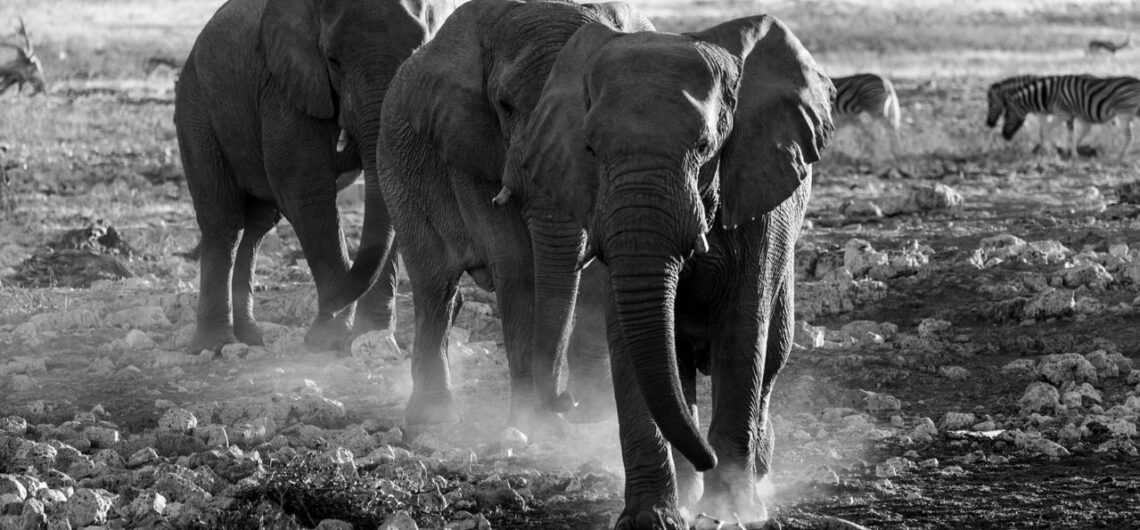
Elephant numbers here are difficult to overstate.
Bwabwata forms a big part of the Kavango-Zambezi Transfrontier Conservation Area, a five-nation initiative larger than Germany and Austria combined, and the park’s rivers are a principal crossing point for huge herds of elephant moving between Botswana, Namibia, Angola and Zambia.
If you stand near the Kwando in the late afternoon, you may watch a hundred or more cross within the hour, slowly, with the matriarchs testing the current before allowing their young calves to walk across.
Buffalo are also frequently seen in the park.
In fact, Bwabwata is widely regarded as the best place in Namibia to see them, with herds numbering in the hundreds moving through what is known as the Buffalo core area and along the floodplains.
Lion, leopard, cheetah and spotted hyaena all tend to follow where the buffalo go, and the park remains one of the last Namibian refuges for African wild dog, a species now rare enough across the continent that any sighting is one that you will be retelling for years afterwards.
The rivers themselves are also full of life.
Sightings of hippopotamus and crocodile are near certainties on any boat trip. Sitatunga, a shy, semi-aquatic antelope with splayed hooves built for wading through papyrus, live almost nowhere else in Namibia in any real numbers but here in Bwabwata.
Red lechwe move through the floodplains in loose herds, roan and sable antelope favour the drier woodland further from the water, and greater kudu, tsessebe, wildebeest and zebra fill in the rest of the picture.
Birders tend to lose track of time in Bwabwata, and with good reason.
There are close to four hundred and fifty species living here, and the Mahango area alone is classed as an internationally important bird area.
Wattled crane, slaty egret, African skimmer, Pel’s fishing owl and the striking southern ground hornbill all turn up with enough regularity that you’ll want to make sure that you pack a good camera and a decent pair of binoculars so that you can get a nice, up close view of them, and maybe a portrait or two.

When is the Best Time to Visit Bwabwata National Park?
The dry season, running roughly from May to October, is when Bwabwata wildlife can be seen in abundance.
Much like the rest of Southern Africa, during the dry winter months, the bush dies back away from the water, and elephants, buffalo and antelope concentrate along the Kwando and Okavango in large numbers, making game drives and boat trips extraordinarily eventful.
June through August brings the coolest, most comfortable temperatures for spending long days outdoors, while September and October turn hot and dusty, with animal sightings at their most concentrated as the land thirsts for the first rejuvenating rains.
The wet months, from November to April, tell a whole different story.
Rain turns the woodland into a deep green, migratory birds arrive in their thousands, and the floodplains fill with life in an almost theatrical fashion after the dustiness of winter.
Wildlife disperses more widely across the park during this period, which means sightings require a bit more effort and a lot more patience, but if you travel during this off-season, the landscape is one that few visitors ever photograph; lush and humid and startlingly alive.
Whichever season you choose, you need to keep in mind that Bwabwata sits within a malaria area, and for that reason you will want to have a chat with a travel doctor about suitable prophylactics well before your departure.

Where to stay in Bwabwata National Park?
Accommodation within Bwabwata tends toward the intimate and luxurious rather than the sprawling and conventional. In a way, this is a reflection of the park’s low-impact, community-partnered approach to tourism.
Nambwa Tented Lodge, set within the Kwando core area on stilts above the floodplain, is one of the most sought-after places to stay in the region. Its tented suites look directly onto water that draws elephant and buffalo throughout the day.
Kazile Island Lodge, positioned on its own island in the Kwando River, will give you a similarly immersive stay with a genuine sense of being removed from anywhere else.
For those travelling toward the western, Mahango side of the park, Mahangu Safari Lodge and the riverside Ngepi Camp both make comfortable, well-placed bases, the latter known for its slightly eccentric charm and a swimming pool that floats directly on the Okavango.
Namushasha River Lodge, a little further east along the Kwando, rounds out the more established options.
Self-drive travellers with a 4×4 are equally well catered for.
There are three community-run campsites, at Ngoabaca near Popa Falls, Nambwa, and Bum Hill, that will put you directly under the same trees the wildlife walks past each morning. These sites are run by the conservancies themselves and will give you a rather more grounded way to experience the park.

Bwabwata National Park deserves a spot on your itinerary, especially if you want to see a different side of the country.
Bwabwata National Park lies in northeastern Namibia, within the Zambezi region, bordered by the Okavango River to the west, the Kwando River to the east, Angola to the north and Botswana to the south.
Bwabwata is named after a village within the park and translates loosely from the local language as the sound of bubbling water, a reference to the rapids and channels along its rivers.
Bwabwata is known for large elephant and buffalo populations, along with lion, leopard, cheetah, spotted hyaena and one of Namibia’s last remaining wild dog populations. Hippo, crocodile, sitatunga and red lechwe are common along the rivers, and close to 450 bird species have been recorded.
The dry season, from May to October, will give you the best wildlife viewing as animals gather near the rivers. The wet season, from November to April, brings migratory birds and lush green scenery, though sightings require more patience.
Yes. Bwabwata offers some of Namibia’s best buffalo and elephant viewing, a genuine wild dog population, rich birdlife and a distinctive community-based conservation model, all with fewer visitors than better-known parks such as Etosha.
