

Walking through the thornveld at Okonjima just after dawn, our tracker’s antenna picked up a very faint pulse, and, carefully and as quietly as we could, we followed the signal on foot through waist-high grass still silvered with dew.
The tracker had picked up the signal of a leopard, and at a respectful distance, one safe enough for both the animal and us, we patiently walked closer to its location in the same way researchers have done here for decades.
There are few places in Namibia, perhaps in the whole of Africa, where you can, along with a guide, track big cats, and fewer still that will let a visitor stand quite so close.
But Okonjima Nature Reserve, which sits in the Omboroko Mountains, roughly two and a half hours north of Windhoek, is home to the Africat Foundation, one of the country’s longest-running big cat conservation organisations, and is one of the best places to have just such an experience.
This is not a roadside attraction with a few enclosures and a gift shop. It is a working reserve where rehabilitation, research and tourism sit alongside one another, each funding and informing the other.

Why Visit Okonjima Nature Reserve
Most safari itineraries in Namibia are fairly similar, in both the featured destinations and pace.
Sossusvlei one week, Etosha the next, and a coastal detour if time allows. Okonjima is one of the safari destinations that often gets completely left off.
The reserve consists of 22 000 hectares of what was once mountain and bushveld used for farming. The land has been painstakingly returned to wilderness in a process carried out over more than thirty years, and that commitment to conservation can be seen in the density and health of the wildlife now living there.
The reserve was purpose-built around the Africat Foundation’s conservation work, which began in the 1990s when local farmers, aided by the Hanssen family, who founded Africat, started caring for orphaned and injured carnivores rather than removing them from the land.
That single decision has determined everything that followed, and it gives a visit here a real sense of purpose, one that goes beyond ticking off sightings, as your visit contributes to the continuation of the foundation and its important work.
What Activities Are There to Enjoy
The most popular activity also happens to be the biggest reason why people come here in the first place.
Guests can join guided leopard tracking on foot or by vehicle, following the signals sent from collared animals across the reserve with an experienced tracker narrating the terrain as they go.
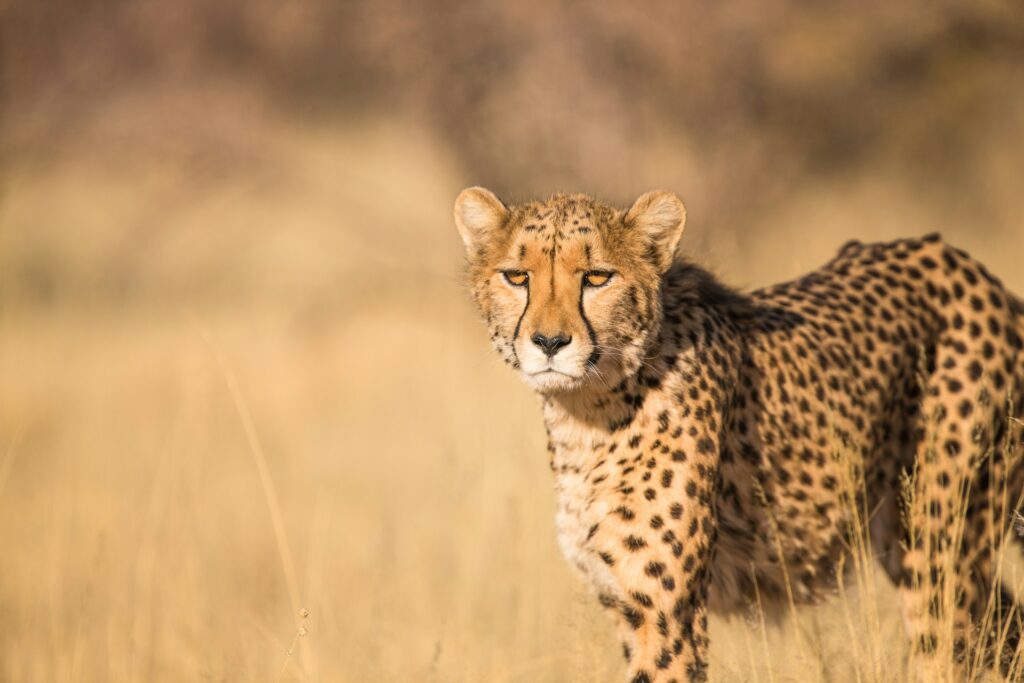
Cheetah tracking runs on a similar principle, usually earlier in the day, when the cats are most active, and the light is soft enough to hold onto.
Aside from the tracking, there are guided nature drives through the reserve’s varied terrain, which changes from open plains to rocky outcrops, and there are also night drives that show off a different Okonjima entirely, with aardwolf, porcupine, and the occasional pangolin moving through the dark.
A visit to the AfriCat Information Centre and its viewing hide rounds out the experience nicely, and it is particularly fun for families or anyone short on time.
What Animals Live in the Reserve
Okonjima is best known for its leopard population. In fact, it is home to one of the highest concentrations of wild leopard anywhere in Namibia, largely a result of decades of protection and habitat restoration.
Cheetahs are also regularly seen moving through the open grassland in the reserve’s southern reaches, while brown hyena and caracal can also call the park home, although they are present in smaller, more elusive numbers.
The reserve has kudu, oryx, warthog and a healthy population of smaller mammals, all of which can be seen throughout the ecosystem, and birdlife is something to behold, with the various raptors being a highlight for anyone travelling with binoculars.
About The Africat Foundation and Why You Must Make Time to Visit
The Africat Foundation has treated and released well over a thousand carnivores since it began, and its current focus sits on research, rather than housing the animals long-term.
Radio collaring, population monitoring and community education programmes across northern Namibia form the backbone of its work, much of it funded directly by guest visits to Okonjima, which is a major reason why you should make the time to visit here.
A stop at the Africat Foundation’s headquarters, with its small museum and rehabilitation facility, answers the question every safari guest here eventually asks, which is what happens to an animal once the vehicle drives away, and how can a place like this keep a species like the Namibian leopard from completely disappearing.
For travellers building a Namibia itinerary that already includes Etosha or the Skeleton Coast, Okonjima fits naturally as a stop between Windhoek and the north, and it can give you something the bigger reserves rarely can: proximity, purpose, and a morning spent following one of Africa’s most intriguing animals on foot.

The Africat Foundation is known for its long-running work rehabilitating and researching Namibia’s large carnivores, particularly leopard and cheetah, from its base at Okonjima Nature Reserve.
Okonjima sits roughly two and a half hours’ drive north of Windhoek, making it a practical first or last stop on a Namibia self-drive route.
Yes, guided leopard tracking on foot or by vehicle is one of Okonjima’s signature activities, using radio collar signals to locate specific animals within the reserve.
Both work well. A single tracking activity and a stop at the information centre can be done in half a day, though an overnight stay allows time for a nocturnal drive as well.
Yes, guest activities and accommodation revenue at Okonjima fund the Africat Foundation’s research, rehabilitation and community education programmes across northern Namibia.
