

Roughly a kilometre before you reach Cape Cross Seal Reserve, you’ll want to put your windows up, and someone in the vehicle is guaranteed to say something that makes everyone laugh.
You won’t see the colony yet; you won’t even hear it properly, but you can smell it, carried on the cold Atlantic wind in a way that is bracingly and unmistakably animal.
It is the smell of tens of thousands of living creatures going about their lives with complete indifference to your presence.
Cape Cross and the Cape fur seals in Namibia are a true wildlife experience.
It might not be as comfortable as enjoying a sundowner on the Etosha plains might be, but as loud, raw and a little smelly as it can be, it is one destination that is going to absolutely blow your mind.
About Cape Cross Seal Reserve in Namibia
Cape Cross Seal Reserve sits on the Skeleton Coast approximately 120 kilometres north of Swakopmund, on a narrow strip of shoreline where the cold Benguela Current meets the Namibian coastline.
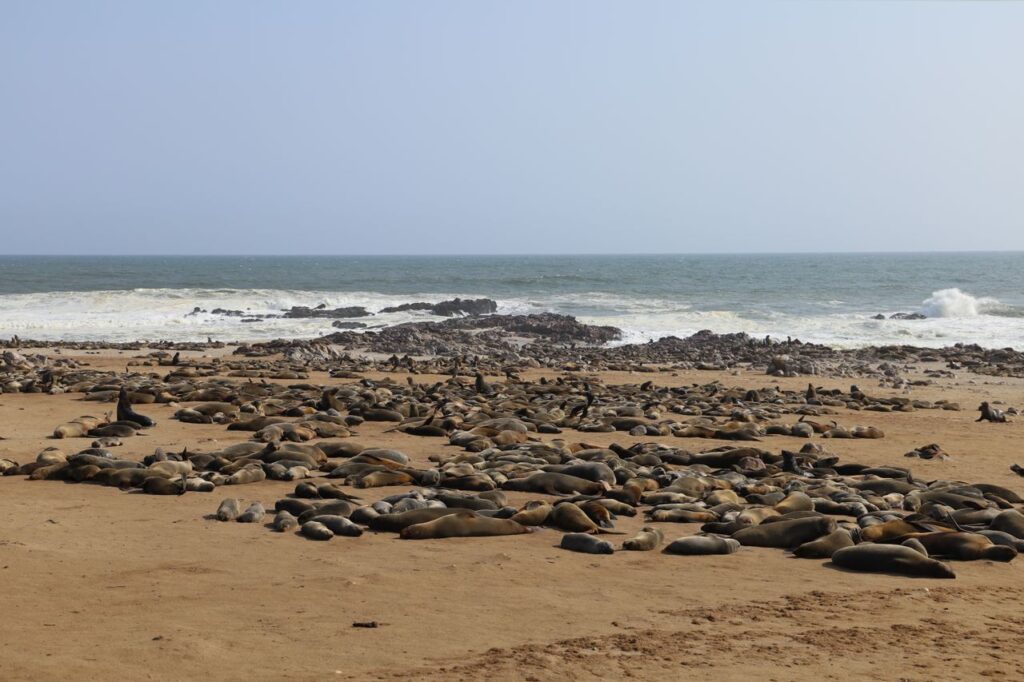
The reserve protects one of the largest free-roaming colonies of Cape fur seals in the world, with estimates placing the population at between 80 000 and 100 000 individuals at peak season (hence the whiff).
To put that number in some kind of physical context: the colony covers several kilometres of beach!
The sound carries further than you’d expect, and the energy of the place, the constant movement, the calling, the jostling, the pups weaving between enormous bulls, is unlike anything else in southern Africa.
Something you might not know is that the Cape fur seal, known scientifically as Arctocephalus pusillus, is not actually a true seal.
It belongs to the eared seal family, which means it can rotate its rear flippers forward and move on land with considerably more agility than a true seal.
This is important to keep in mind when you are standing at the viewing barriers and a large bull decides to investigate you. They move fast, and several visitors discover this the hard way every year.
The reserve is also historically important.
A replica of the cross erected by Portuguese explorer Diogo Cão in 1486 stands near the entrance, marking one of the earliest recorded European landings on the Namibian coast.
The original cross was removed to a museum in Berlin in the late nineteenth century, and although the cross is not original, the location is, and standing there with the Atlantic behind you and the colony ahead, the sense of time and remoteness is something to behold.
What to Expect from Your Visit
The reserve is accessed via a well-maintained gravel road, and the entrance is easy to find.
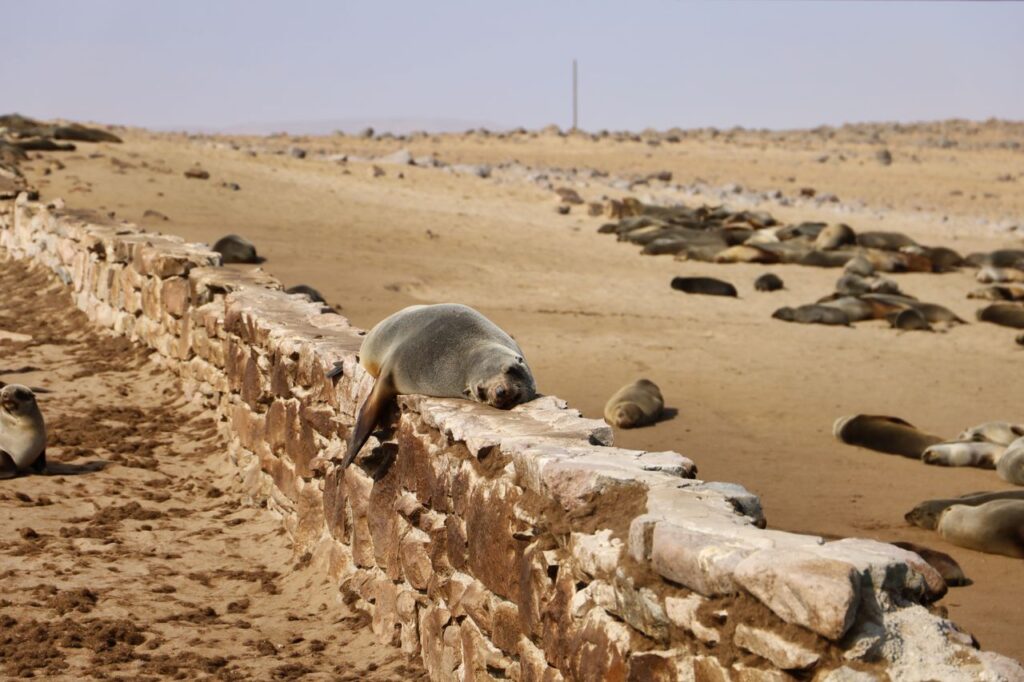
A boardwalk and series of viewing barriers run along the colony’s edge, allowing visitors to get close to the seals without disturbing the animals or entering the colony itself.
The word close is worth talking about a little bit.
At Cape Cross, close means very close.
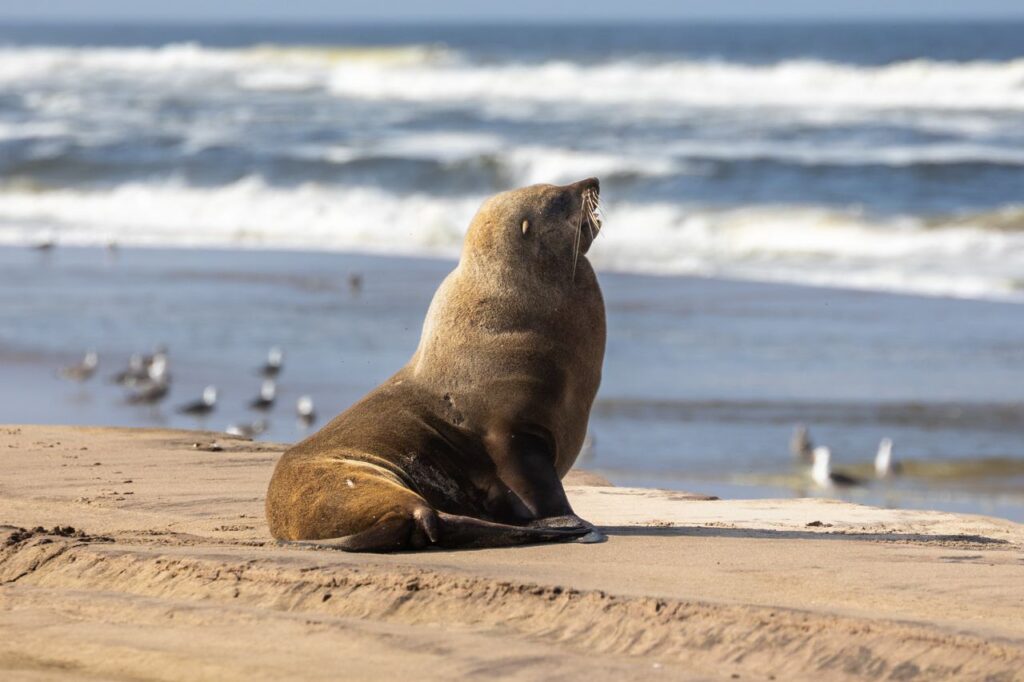
Bulls weighing up to 300 kilograms rest within metres of the viewing barriers, the mothers nurse pups at eye level, and the young males practice their aggressive posturing that will eventually determine their place in the hierarchy. Their posturing is impressive and kind of comedic.
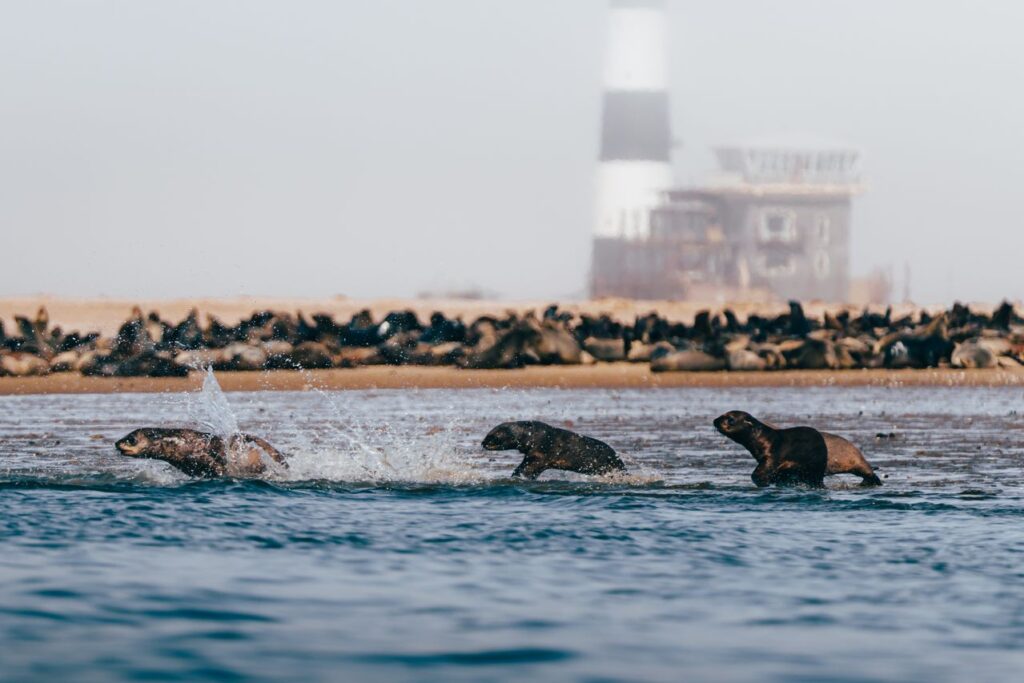
The pups, particularly in the months following the main birthing season, are a study in determined chaos.
The smell, already mentioned, intensifies the closer you get to the colony. It is the result of tens of thousands of animals, fish, guano, and the cold salt air of the Skeleton Coast. It is not subtle, so bringing a buff or light scarf is recommended.
The noise is the other thing that catches visitors off guard.
The colony is never quiet. The bulls produce a deep, resonant bark, and the females call constantly to locate their pups in the crowd. The pups themselves produce a sound somewhere between a bleat and a cry.
Within ten minutes of arriving, most visitors stop noticing it, and within twenty, they are listening for specific calls within the general chorus.
Plan for at least ninety minutes at the reserve. An hour is not enough.
Fascinating Facts about Cape Fur Seals
Cape fur seals are remarkable animals.
A female seal can identify her own pup by call alone within a colony of tens of thousands of animals. She returns from fishing trips of several days, calls once, and the pup answers. They find each other every time.
Bull Cape fur seals in Namibia can weigh up to 300 kilograms and measure over two metres in length. Females are considerably smaller, typically around 75 kilograms, which makes the size difference between the sexes one of the most pronounced of any seal species.
Pups are born between November and December, with the peak of the birthing season falling in late November. This is also the period when the bulls are most actively defending territory, which makes late November and December the most extraordinary time to visit, though it is also the most crowded in terms of animal activity and guests.
Cape fur seals are strong swimmers and can reach speeds of up to 20 kilometres per hour in the water. On land, they are slower but considerably more mobile than most visitors anticipate.
The Benguela Current that runs along this stretch of coastline is rich in fish, particularly anchovy and pilchard, which is why the colony established itself here and why it has remained one of the largest in the world.
The Skeleton Coast got its name from the whale and seal bones that once lined this stretch of shore, left by the whaling and sealing industries of the nineteenth century, and Cape Cross was a significant sealing station during that period. The reserve today is a conservation area, but the history of what happened here should never be forgotten.
How to Reach Cape Cross Seal Reserve
Cape Cross is located on the C34 coastal road, approximately 120 kilometres north of Swakopmund and around 60 kilometres south of Henties Bay. The road is accessible by standard vehicle, though a 4×4 is always a sensible choice on Namibian gravel roads.
The drive north from Swakopmund along the C34 is one of the more cinematic roads in Namibia. The Skeleton Coast is to the left, cold and grey and seemingly never-ending, while the desert presses in from the right.
There are stretches where the road seems to exist at the edge of everything.
From Windhoek, Cape Cross is approximately a four-to-five-hour drive, making it a destination best visited as part of a multi-day coastal itinerary rather than a day trip from the capital.
Entry fees apply and are payable at the reserve gate, and the reserve is open daily, usually from 08h00 to 17h00, though hours can vary seasonally, so you’ll want to confirm with the reserve in advance.
When is the Best Time to Visit Cape Cross to See the Seals?
Cape Cross is worth visiting at any time of year, but two seasons stand out for different reasons.
November to January is the birthing and mating season.
The colony is at its most populated and its most active. The energy of the place during this period is extraordinary, and for that reason alone it is the best time to visit if you want to see thousands of seals.
May to August brings cooler, clearer conditions along the Skeleton Coast.
The colony is quieter in terms of seasonal activity, but the animals are present year-round, and the light in winter along this coastline has a particular quality, flat and silver and cinematic, that makes it wonderful for photographers.
Midday visits in summer can be intensely hot, and the heat can make the smell worse. Early morning visits are the most comfortable.

Plan your Namibia coastal itinerary with Namibia Safaris
Cape Cross is a natural addition to a longer Skeleton Coast or coastal Namibia itinerary, and can be included in a tour that’ll take you to Swakopmund, the Moon Landscape, Walvis Bay, and the dune landscapes of the Namib to the south.
The colony at Cape Cross is one of the largest Cape fur seal colonies in the world, with estimates ranging from 80 000 to 100 000 individuals at peak season. Numbers fluctuate throughout the year, with the highest populations recorded during the November to January birthing and mating season.
November to January is the most dramatic period, coinciding with the birthing season when pups are born, and bulls are actively defending territory. May to August offers cooler, clearer conditions with excellent light for photography. The colony is present and active year-round, so there is no poor time to visit, only different experiences depending on the season.
Cape fur seals are wild animals, and bull males in particular can be territorial and move faster than most visitors expect. The viewing barriers at Cape Cross keep visitors at a safe and respectful distance from the colony. Staying within the designated viewing areas is both a safety requirement and a conservation practice.
Cape Cross is located approximately 120 kilometres north of Swakopmund on the C34 coastal road. The drive takes around one and a half to two hours on gravel road and is accessible by standard vehicle. Most visitors include Cape Cross as a day trip from Swakopmund or as a stop on a longer Skeleton Coast itinerary.
The intensity of the smell at Cape Cross is the result of a colony of up to 100,000 animals living in close proximity, combined with fish, guano, and the cold salt air of the Benguela Current coastline. It is one of the most commonly mentioned aspects of a Cape Cross visit and is generally considered part of the authentic wildlife experience rather than a drawback.
