

I took the road out of Swakopmund, after a few days spent exploring this fascinating small town, and took the road inland, away from the cold Atlantic and the salt-hazed coastline.
I drove for about twenty minutes before the town behind me disappeared entirely.
The sight that started to appear on the horizon is a little hard to put into words.
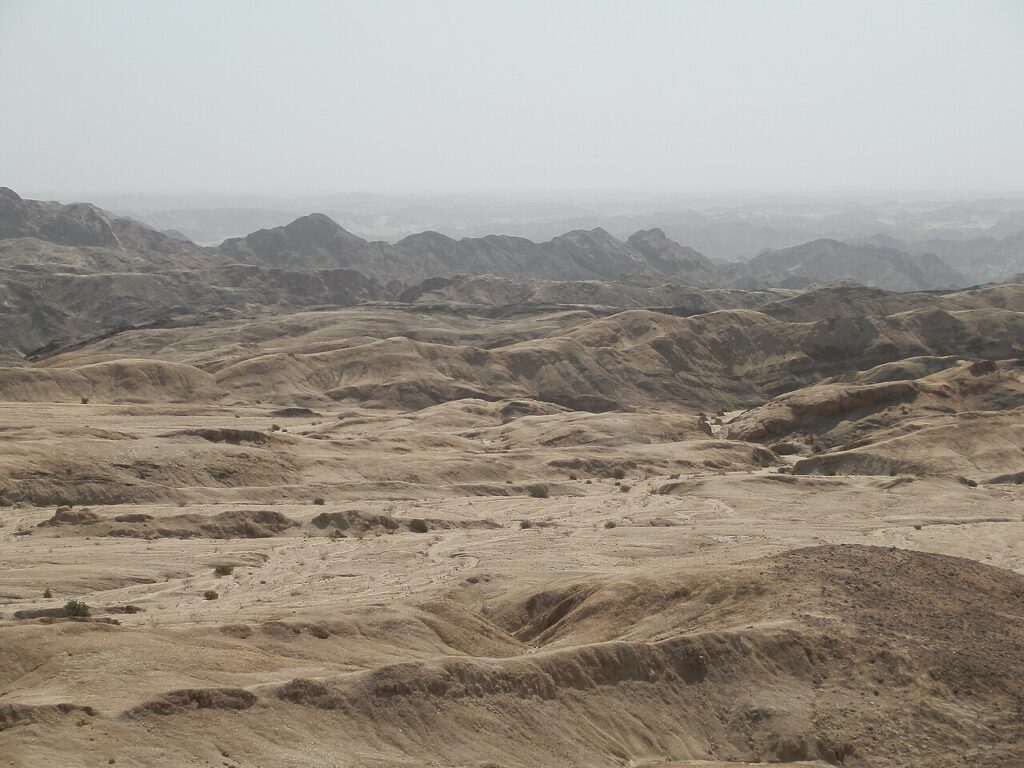
The ground dropped away into a series of eroded gullies and pale, folded ridges that looked as though they belonged to a planet still figuring itself out.
The sky was wide and clear, and somehow it looked so much bigger than usual, and the only sound was the faint rustle of bone-dry grass.
I had the overwhelming impression that I had driven off the edge of the known world and landed somewhere simply not of this world.
This is the moon landscape in Namibia. And while it is obviously not the moon, it is also not quite like anywhere else on Earth either.
What is the Moon Landscape?
The moon landscape in Namibia is a stretch of ancient, heavily eroded terrain about 30 kilometres east of Swakopmund, and you’ll find it easily if you follow the Swakop River valley.
What visitors see today is the result of millions of years of geological weathering, a process in which the Swakop River carved deeply through the layers of granite and schist, leaving behind a corrugated, crater-pocked landscape of pale grey and ochre ridges that bear an uncanny resemblance to the lunar terrain.
The rocks themselves are among the oldest exposed surfaces on Earth.
The granite in the area dates to approximately one billion years, making the Moon Landscape not just a visually extraordinary place to explore, but also geologically significant. It’s quite something to stand here, knowing that some of the rocks beneath your feet are older than the dinosaurs!
When planning your visit, don’t make the same mistake that many make, in thinking that the Moon Landscape is a single viewpoint or a single stop.
It is a whole area of rock, with the most dramatic sections visible from a well-positioned lookout point roughly 30 kilometres from Swakopmund. Most visitors stop here to take some photos and enjoy the view, while the more curious ones follow the road farther, where the landscape continues to twist, turn, and change shape.

The Welwitschia Connection
The Swakop River valley is not just a place to see a bunch of ancient, moon-like rocks.
It is also home to one of the most accessible concentrations of Welwitschia mirabilis plants in Namibia, and this is where your Moon Landscape excursion can become something so much more than a scenic drive.
Welwitschia mirabilis is a living fossil, a desert plant so ancient and so unlike anything else on Earth that it occupies its own taxonomic family entirely.
Individual plants in the Swakop River valley are estimated to be between 500 and 1 500 years old. They grow slowly, they grow low, and they are completely unbothered by the passage of time.
Seeing billion-year-old rock formations and thousand-year-old plants in a single half-day drive is not your average getaway, and yet it seems to perfectly fit the personality of Namibia.
You can read a full guide to Welwitschia mirabilis, including the science behind its extraordinary longevity and where else to find it across Namibia, here.
What to Expect from Your Moonscape Visit
The Swakop River valley is best seen in the early morning.
The mist that rolls in from the Atlantic overnight tends to linger here longer than it does on the coast, softening the ridgelines and giving the pale rocks a luminous, slightly ethereal quality, especially when paired with that gorgeous morning light.
By mid-morning it burns off, and the scenery sharpens, becoming harsher on the eyes and a lot more dramatic.
That said, both versions of the landscape are worth seeing, and if you plan your trip to leave from Swakopmund, you’ll have more than enough time to experience both and head off to your next destination before the sun sets.
The lookout point at the moonscape is modest in infrastructure, but it will treat you to a generous view.
There is space to stop, to walk a short distance along the ridge, and to simply stand and admire the valley spread out below. You don’t have to rush the experience; I spent a good amount of time taking it all in because I knew I would probably not pass this way again.
If you’d like to go further, you can arrange guided excursions into the valley floor, where the Welwitschia plants grow in clusters among the river gravel, and the sense of geological scale becomes even more pronounced.
The valley floor is not accessible by standard vehicle in all conditions, so checking road conditions before heading down is worthwhile.
Often, travel companies include this area in their itineraries because it is so close to Swakopmund.

The Moon Landscape as Part of a Swakopmund Itinerary
Swakopmund is one of Namibia’s most loved towns, a place of cool air, good coffee, colonial architecture, and the sort of laid-back good vibes energy you’d expect from any other coastal town.
It sits at the meeting point of the Namib Desert and the Atlantic Ocean, and it functions naturally as a base for several of the surrounding region’s most interesting excursions.
The Moon Landscape is the most atmospheric of these, and it pairs naturally with a morning at the Swakop River Welwitschia Plains, a visit to the Living Desert for an introduction to the Namib’s smaller inhabitants, or an afternoon on the dunes near Walvis Bay.
Together these excursions will give you a good sense of the Namib’s extraordinary range, from the coastal fog belt to the ancient interior, within just a day or two of relaxed exploration.
For those moving through on a longer Namibia itinerary, Swakopmund typically sits between a visit to the dune landscapes of Sossusvlei to the south and a safari-focused trip to the wildlife-rich plains of Damaraland and Etosha to the north.
The Moon Landscape fits neatly into a morning before the road continues, a last look at something strange and beautiful before venturing off into the more remote parts of the country.
Your stop might not take all that long, but it sure is going to stay with you forever.
Some Practical Information
The Moon Landscape lookout is accessible by standard vehicle along the C28 road east of Swakopmund, and the drive takes approximately 30 minutes from the town centre.
There is no entrance fee for the lookout point itself, and guided half-day excursions into the Swakop River valley, including Welwitschia viewing, are available through tour operators in Swakopmund and can be arranged as part of a wider itinerary.
The best time to visit is early morning, both for the quality of the light and for the cooler temperatures.
Midday in the valley can be considerably warmer than the coast, especially during the intense summer months.
There is no shade at the lookout point, and within the area in general, so you’ll want to make sure that you bring enough water and have appropriate sun protection.
Plan Your Namibia Itinerary with Namibia Safaris
Namibia Safaris designs itineraries that move through the country with the kind of care that only comes from knowing it well. Swakopmund and the Moon Landscape feature across several of our routes, as a natural rest point between the dramatic dune landscapes of the south and the wide open wildlife country of the north.
For travellers who want to see Namibia at the right pace, with the right context, and without missing the places that do not always make the front page of the brochure, we’re a natural first choice.
The Moon Landscape is an ancient, eroded river valley approximately 30 kilometres east of Swakopmund, carved by the Swakop River through billion-year-old granite and schist. The resulting terrain of pale ridges, gullies, and crater-like formations bears a strong resemblance to lunar terrain, which is where the name originates.
The Moon Landscape is reached via the C28 road heading east out of Swakopmund. The drive takes approximately 30 minutes, and the road is accessible by standard vehicle. The main lookout point is well signposted and has space to park.
Yes, particularly for travellers who appreciate landscapes that are geological rather than purely scenic. The combination of extraordinary rock formations, ancient Welwitschia plants, and the quality of the light in the Swakop River valley makes it one of the more quietly memorable excursions in the Swakopmund area.
Yes. The Swakop River valley is one of the most accessible places in Namibia to see Welwitschia mirabilis in the wild. Several plants in the area are estimated to be between 500 and 1,500 years old. Guided excursions into the valley floor offer the best viewing opportunities.
Early morning is strongly recommended. The Atlantic mist that settles over the valley overnight creates an atmospheric, softened quality to the light that burns off by mid-morning. Temperatures are also considerably more comfortable in the early hours than at midday.
