

Somewhere on the gravel road between Khorixas and the Skeleton Coast, I noticed the atmosphere and the landscape starting to change.
The light became flat and white. The air began to carry that faint smell of dust and dry grass. And then, without ceremony, a small sign appeared at the roadside, announcing that I was passing into an ancient place.
It was winter and the conditions were perfect for a Namibian road trip. This is a country I have wanted to travel to my whole life, and while the world seemed to be becoming more topsy-turvy than usual, I decided to book that trip. I had the feeling in my bones that it was now or never.
In my first week in the country, I hit all the hot spots. I spent a few days in Windhoek, and realised that it is so much smaller than I had imagined. A few days was really all I needed to see it all.
Then I headed out into the wild and unknown (at least, unknown to me). I went west first, travelling down the Skeleton Coast and visiting Swakopmund, and then I drove east to Damaraland to see one of Namibia’s most fascinating sights.
What is the Petrified Forest in Namibia, Exactly?
The name of this place sets up an expectation the site does not quite meet.
There is no forest, at least not in the conventional sense. No trees are standing upright, stripped of their colour, frozen mid-growth.
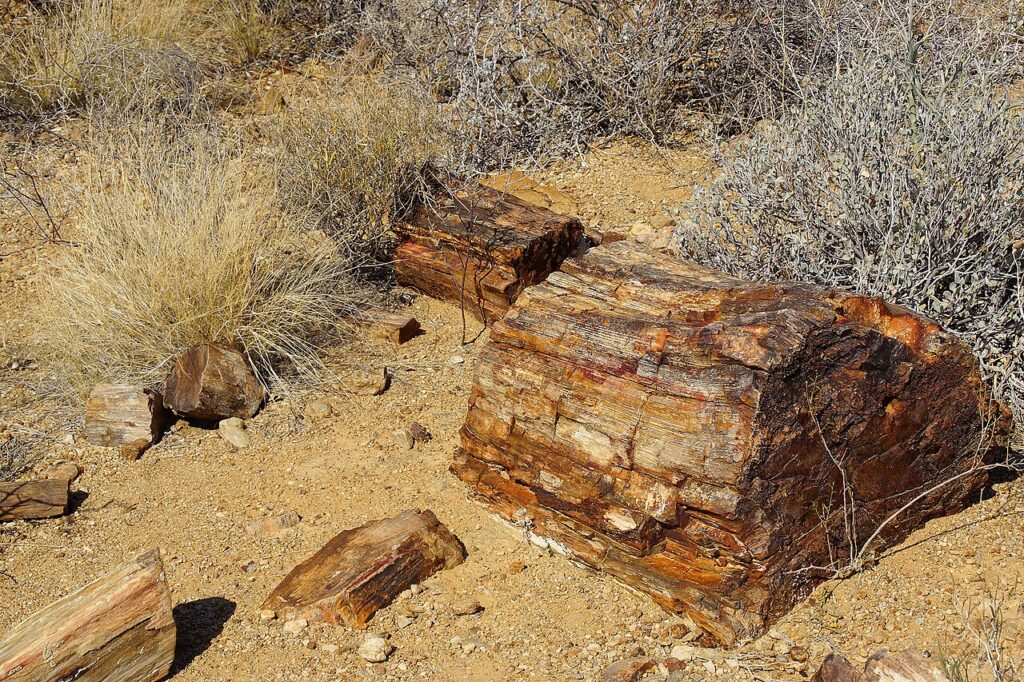
What there is, scattered across roughly 300 by 800 metres of open Damaraland scrubland, are the trunks. Enormous, horizontal, broken into pieces by time and weather but otherwise astonishingly intact.
Some stretch to 34 metres in length, the largest reach six metres in circumference, the annual growth rings are still visible, and the bark texture is still there.
These trees are completely petrified, meaning they have turned entirely into stone.
Around 50 individual trunks are exposed at the official site near Khorixas, with several hundred more thought to lie partially buried in the surrounding desert terrain.
They belong to an ancient group of cone-bearing plants called Gymnosperms, the ancestors of modern conifers and cycads, and they are believed to have floated here on a prehistoric floodwater event during the Permian period, carried down from what is now Angola, before being buried under alluvial sediment.
Deprived of oxygen, they could not decompose.
Instead, over millions of years, each cell was individually replaced by silica in a process called silicification. The result is wood that is, technically, quartz. The same hardness as a crystal.
In 1950, after souvenir hunters began helping themselves to fragments, the site was declared a National Monument. It is now a protected heritage site, and the minimum fine for removing even a small piece of petrified wood is 5 000 Namibian dollars.
The trunks have survived 280 million years. The rules are there to make sure they survive the next hundred.

What it’s Like to Walk Through the Forest
I’m not going to be cliché and say it’s a humbling experience. But it sure is one of the most interesting places you’ll ever see.
A guided walk is compulsory; you cannot explore here as you would in, say, Kolmanskop.
The guides at the Petrified Forest are knowledgeable, never in a hurry, and incredibly proud of what they are showing you.
They will point out the growth rings, they will tell you which trunks have been partially excavated and which are still emerging from the earth, and they will show you the places where the stone has fractured along the original grain of the wood.
Give yourself at least an hour here but aim for more.
The walk is approximately 800 metres and mostly flat, which makes it accessible, but the heat in Damaraland is not to be underestimated. Early morning visits are considerably more comfortable, and the quality of the light at that hour does something rather lovely to the colour of the stone.
The site also lies within a semi-desert environment rich in unusual flora.
Alongside the petrified trunks, visitors will find Welwitschia mirabilis plants growing in the surrounding scrub.
These are among the most extraordinary plants on Earth, ancient, slow-growing desert survivors that can live for over a thousand years. They look like nothing else you’ll see, in Namibia or elsewhere.
You can read up more about the Welwitschia plant, including what makes them so remarkable and where else they appear across Namibia, here.
How to Get There and What to Know Before You Go
The Petrified Forest is located approximately 40 kilometres west of Khorixas on the C39 road, in Namibia’s Kunene Region, in Damaraland.
The road is gravel but generally in good condition and accessible by standard vehicle, though a 4×4 is always preferable on Namibian gravel roads if you are driving yourself.
Entry fees are approximately 250 Namibian dollars per person, and this includes a government-appointed guide. The site has covered parking, which is a small but welcome detail on a hot Damaraland morning.
There are several privately run roadside sites in the area advertising petrified trees. These are not the official National Monument. They vary considerably in quality and conservation standards. For the full context, proper guiding, and the most significant trunks, the official site is the one to visit.
The Petrified Forest as Part of a Damaraland Itinerary
The Petrified Forest is often treated as a stop on a longer route through Damaraland.
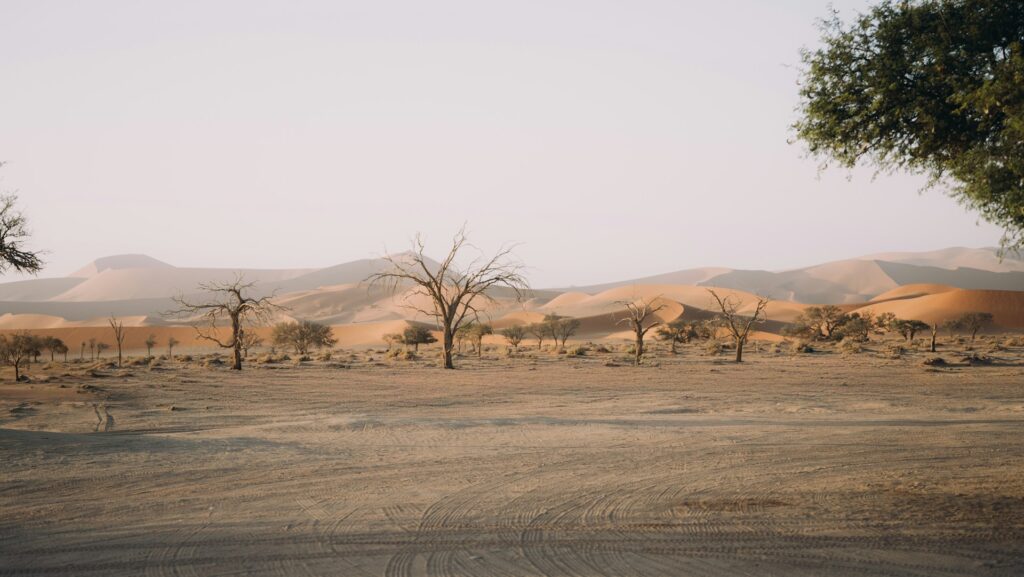
The region is one of Namibia’s most scenically beautiful spots, a landscape of flat-topped mountains, open plains, and, during the off-season in particular, a lovely silence that makes the experience even more peaceful.
Within easy reach of the Petrified Forest are Twyfelfontein, the UNESCO World Heritage Site where thousands of San rock engravings cover the sandstone hillside, and the Organ Pipes, a dramatic formation of parallel dolerite columns rising from a dry riverbed a short distance away.
The Burnt Mountain, a geological oddity of scorched-looking shale hills, is also nearby. These sites, along with a visit to the Petrified Forest, can be visited during a half-day or full-day loop from a Damaraland base.
From Damaraland, most itineraries continue north to Etosha National Park, making the Petrified Forest a natural last morning stop before the road turns towards the floodlit waterholes and open plains of Etosha, where I spent the next part of my holiday on safari.
That said, it would be a mistake to treat the Petrified Forest as merely a tick on the way to somewhere else.
While it is not dramatic in the conventional sense and there are no animals and no sweeping views. The stones, the light, and the bewildering knowledge that you are standing next to something that has existed since before the dinosaurs make it one of the Namibia destinations you’ll never forget.

Plan your visit with Namibia Safaris
Namibia Safaris builds itineraries that move through the country with care, connecting visitors with the landscape’s most meaningful sites in a way that allows them to get into the experience fully.
For those who want to see Namibia properly, not quickly, the team at Namibia Safaris is the right place to start.
Yes, particularly for travellers with an interest in geology, natural history, or simply in places that feel genuinely unlike anywhere else. It is not a high-energy destination, but it is a quietly profound one. The scale of the trunks, the visible wood grain preserved in solid stone, and the quality of the guiding make it a memorable stop on any Damaraland route.
The trees are estimated to be approximately 260 to 280 million years old, dating to the Permian period. They belong to an ancient plant group called Gymnosperms and are believed to have been transported to their current location by a prehistoric flood event, possibly originating in what is now Angola.
Yes. Guided tours are compulsory at the official National Monument site near Khorixas. This is not an inconvenience. The guides are knowledgeable, and the context they provide transforms the visit from a walk among stones into something informative.
The site is accessible by standard vehicle via the C39 gravel road, approximately 40 kilometres west of Khorixas. The road is generally in reasonable condition. That said, a 4×4 is recommended for any extended travel in Damaraland, where road conditions can vary.
Most visitors spend between 45 minutes and one and a half hours at the site. The guided walk covers approximately 800 metres of mostly flat terrain. Early morning visits are recommended for cooler temperatures and better photographic light.
