
In this guide, we’re travelling to Hoarusib Valley, where the desert has spent the last 40 000 years creating one of Namibia’s strangest attractions.
Namibia has 4 castles: Duwisib Castle, Heinitzburg, Sanderburg, and Schwerinsburg. Yet unlike these stately relics of the German colonial era, Hoarusib’s Castles have not been made by man.
Rather, nature takes full responsibility for these fascinating structures, and unless you specifically add a detour to your Namibia tour, you might miss out on seeing them.
What are the Clay Castles?
The Clay Castles are a cluster of fine-grained clay formations beside the Hoarusib River in Namibia’s Kunene Region.
The Hoarusib is an ephemeral river, which means it rises near Opuwo and flows towards the Atlantic, carrying surface water only occasionally during the rainy season. For the rest of the year, what you’ll see is a wide, silent corridor of sand and stone.
Rising from that corridor are the castles themselves.
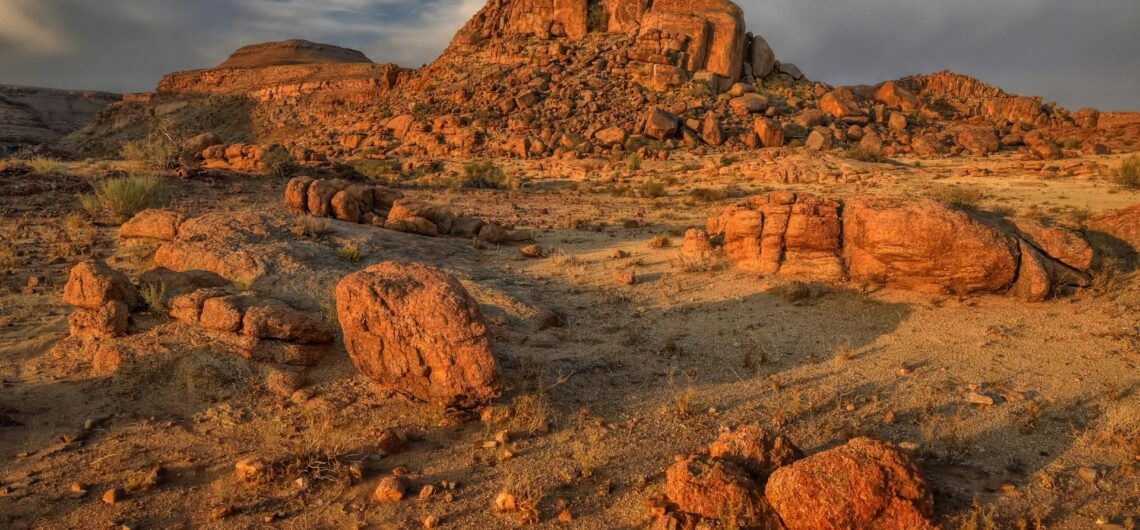
They are layered ridges, fluted walls and slender spires in shades of cream and ochre. In the low light of early morning or late afternoon, they glow, and the resemblance to ruined, ancient castle fortifications is quite uncanny.

How were the Clay Castles formed?
No lost civilisation was involved in the formation of these interesting-looking structures, but that doesn’t make the real story any less intriguing.
According to geological research, the sediments that form the castles were laid down when water from the main Hoarusib channel flooded back into a tributary, leaving behind thick deposits of fine material.
Dating work suggests this happened between roughly 44 000 and 20 000 years ago.
Since then, wind and the occasional rush of water have carved those deposits into the shapes you see today while touring this area of the Skeleton Coast.
The sculpting never really stops, so the Clay Castles you visit won’t be quite the same as those a visitor saw a generation ago. That is what makes most of Namibia such a unique place to visit.
It is one of the very few places on earth that is constantly being changed by the whims of nature, and often within such a short period of time that if you were to have a couple of years between your visits, an attraction like this one will have more than a few subtle changes.
Why the Clay Castles Rank Among the Skeleton Coast’s Most Unusual Attractions
The Clay Castles are not a fly-by destination.
To see them, you’re going to have to travel quite far and prepare well, because these castles are in a remote part of Skeleton Coast National Park, and the best (and probably safest) way to see them is on a guided 4×4 excursion.
Lodges in the area, as well as various Namibia tour companies, have regular guided drives into the Hoarusib River valley, and one of the attractions that you’ll see along the way is the Clay Castles.
In the company of a good guide who knows how to read the riverbed like a book, explaining why the formations sit where they do, where the elephants crossed last night, and which stretch of the valley is best to get lost in for a while, will really make the whole experience so much more memorable and worth the time.
However you choose to visit this part of the country, you’ll want to set out early, stay a good long while so that you get to see all of the finer details, and travel during the dry season, when you’ll have easier access and better chances of seeing some wildlife.
And you’ll often have the entire landscape to yourself, because very few people have the desire, or the time, to travel this far up Namibia’s eerie and desolate Atlantic Coastline.

A Valley Alive with Surprises
The Hoarusib’s surprises don’t end with the clay.
The valley is surrounded by steep walls of dark volcanic rock, and by makalani palms that grow from seeds washed down from upstream. This makes the castles look almost theatrical and, naturally, any photo you take will look like a painting.
The riverbed also works as a natural corridor for wildlife, and with a little luck, desert-adapted elephants may appear while you are visiting the region.
Other animals you might catch sight of include Angolan giraffe, desert lions, springbok, oryx and baboons. The valley might not be Etosha wildlife-rich, but it certainly makes for an intriguing safari destination of sorts.
More of Namibia’s Natural Wonders and Oddities
If the Clay Castles appeal, Namibia has plenty more places that look borrowed from another planet. Once you’ve seen the Skeleton Coast’s attractions, these are worth weaving into the rest of your tour:
- Sossusvlei and Deadvlei. The colossal red dunes surrounded by a white clay pan, where blackened camel thorn trees have stood for centuries, are Namibia’s top attraction. In fact, as many as 600 000 people visit the region each year.
- Fish River Canyon. This is one of the largest canyons in the world, best visited at sunrise from the rim.
- Spitzkoppe. The granite peaks and natural arches that glow orange at dusk, often called Namibia’s Matterhorn, make Spitzkoppe a fascinating sight.
- Twyfelfontein and the Petrified Forest. There are thousands of rock engravings in this UNESCO-listed area, plus ancient fossilised tree trunks near Khorixas.
- Kolmanskop. This diamond-era ghost town near Lüderitz is slowly filling with sand and is an interesting attraction to spend some time in.
- Quiver Tree Forest and Giant’s Playground. The strange, spiky trees and dolerite boulders stacked like a giant’s toys make for quite the memorable sight.
- Fairy circles. The circles are thousands of bare, round patches that can be seen across the Namib grasslands. Their origin is still debated, which makes them a lovely conversation starter.
- Hoba Meteorite. The largest known meteorite on Earth, lying where it fell near Grootfontein, has become a popular attraction.
- Sandwich Harbour. At the harbour, you can see enormous dunes sloping straight into the Atlantic.

Come and See the Unexpected
The Skeleton Coast has a reputation for shipwrecks and silence, but its strangest treasures are older and, in many ways, just as capable of conjuring up your imagination as any hull on the beach.
The Clay Castles show off the desert’s talents as a fine sculptor, working slowly, with wind and water as its tools to create scenes that would look more appropriate on Mars than in the Namib.
To see them in comfort, with expert guides and the right stops along the way, speak to the team at Namibia Safaris about an itinerary that will walk you through the Skeleton Coast and beyond.
They are a cluster of fine-grained clay formations beside the Hoarusib River in Namibia’s Kunene Region. Layered ridges, fluted walls and slender spires in cream and ochre shades give them the look of ruined castle fortifications.
Floodwater from the main Hoarusib channel flowed back into a tributary and left thick deposits of fine sediment. Dating suggests this happened between roughly 44 000 and 20 000 years ago. Wind and occasional water flow have been sculpting the deposits ever since.
They sit in a remote part of Skeleton Coast National Park, in the Hoarusib River valley. The river rises near Opuwo and flows towards the Atlantic, so the castles are a long drive from most standard Namibia tour routes.
A guided 4×4 excursion is the best and safest option. Lodges in the area and various Namibia tour companies run regular drives into the valley. Travel in the dry season for easier access and better wildlife sightings, and set out early.
The dry riverbed works as a natural wildlife corridor. Desert-adapted elephants are the highlight, with Angolan giraffe, desert lions, springbok, oryx and baboons also possible. Sightings are never guaranteed, and the valley is less wildlife-rich than Etosha.
