

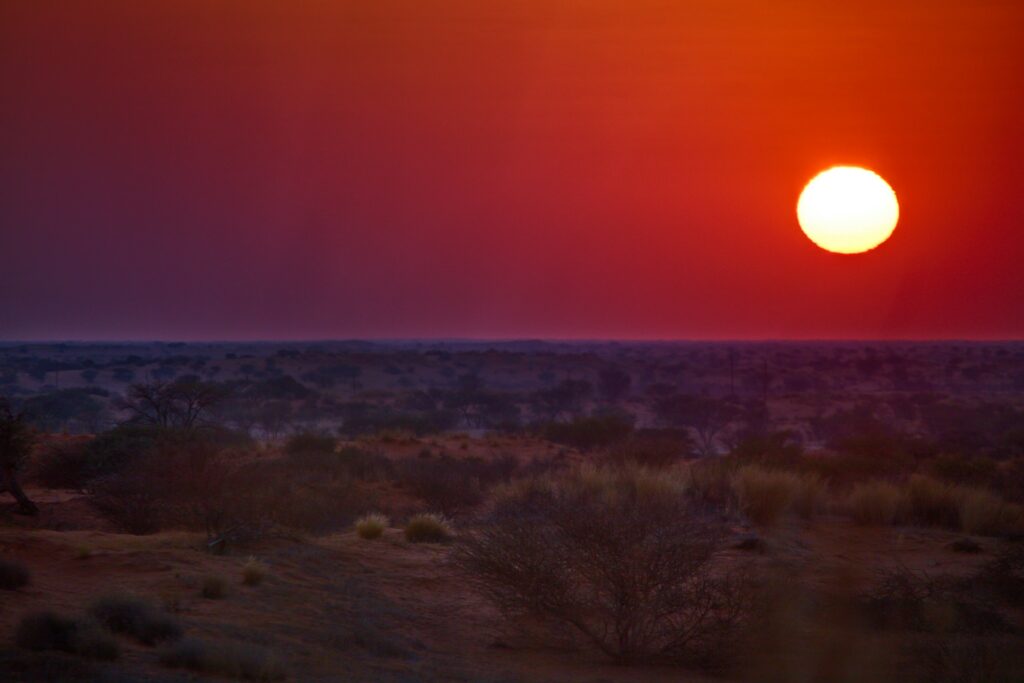
At dusk, when the red sand deepens to something close to rust, the camel thorn trees throw long shadows across the dunes, and the sky, uninterrupted by anything man-made or lit by unnatural light, for as far as the eye can see, turns the most peculiar but absolutely stunning shade of orange.
After spending a couple of weeks travelling through my bucket list of Namibia destinations, I headed south to Namibia’s other desert, the Kalahari.
It was winter, and the nearby, although by nearby I mean a couple of hundred kilometres away, veld fires had contributed to creating the most incredible sunsets. When seeing sights like that, I desperately wish I was a better painter, because the colours are simply unreal.
The Kalahari Desert is one of the most spectacular places on earth, and so few people make the time to see it. While there are no official figures, it is estimated that only around 400 000 people, if that many, come here each year.
Perhaps that is a good thing.
The Kalahari is a sacred place, and you don’t need your guide to tell you that. Walking along these red sands is humbling in the best sense, and you just get a feeling that you are someplace that needs to be protected, even though its harsh environment makes it quite formidable for both travellers and wildlife alike.
One of the most fascinating things about the Kalahari is that it is actually not a desert at all.
And once you are aware of this single fact, everything else you thought you knew about the Kalahari tends to unravel, which is actually a great starting point for your reintroduction to this ancient and in some ways rather odd place.

What is the Kalahari Famous for?
The Kalahari is most commonly associated with 3 things: the San people, one of the oldest indigenous cultures on Earth; the black-maned Kalahari lion, a subspecies so visually unique that it has become one of the most photographed predators in all of southern Africa, and red sand.
These 3 things have made the area a worthy tourist destination if you find yourself travelling to this part of the world.
The desert is also home to meerkats, brown hyenas, gemsbok, cheetah, leopard, bat-eared foxes, and more than 200 bird species, and it has some of the darkest, most star-saturated night skies anywhere in the southern hemisphere.
All in all, it’s a fabulous place for an African adventure!
You can visit the Kalahari from South Africa or from Namibia. In Namibia, the Kalahari forms the country’s southeastern border region, stretching into the dune fields and red sand plains near the Botswana border.
Why is it Called the Kalahari?
The name derives from the Tswana word “Kgalagadi,” which translates as “the great thirst” or “a waterless place.”
Both tell you something real about the landscape, but neither quite captures all of it.
The Kalahari is thirsty, yes. But it is also, in the right season, lush with golden grass, alive with insects, and absolutely full of animals that have learned to live here with a resourcefulness that is to be admired.
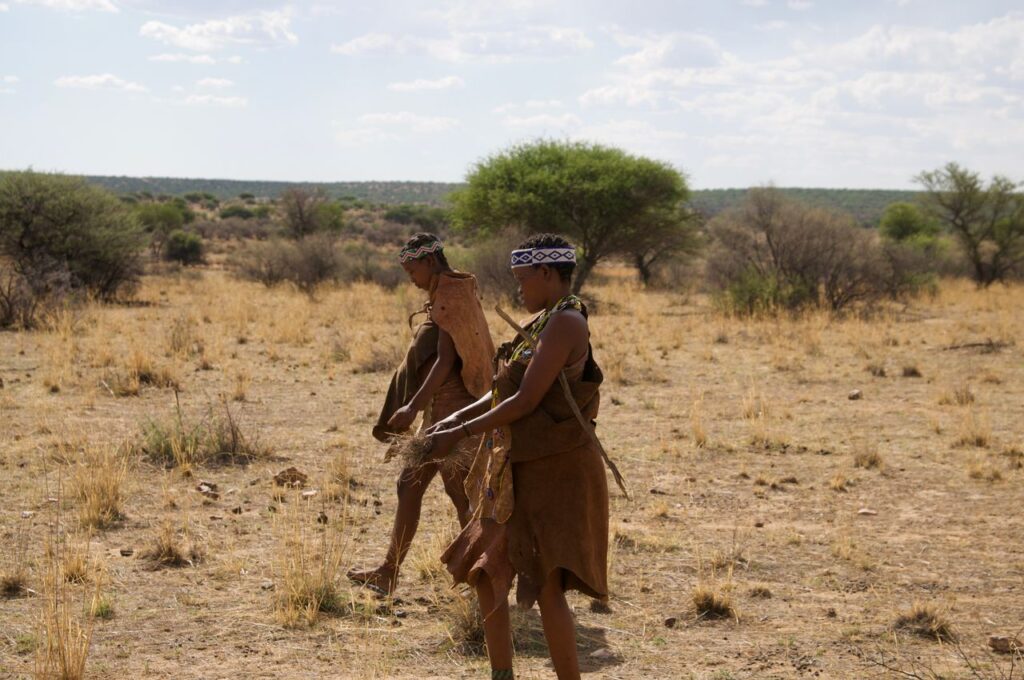
The San people, who have inhabited this landscape for at least 20 000 years, have their own names for this place, and their own relationship with the land, one that predates the Tswana designation by a considerable distance.
What are some Fun Facts about the Kalahari?
Now for the really fun stuff. You would be terribly mistaken if you thought a desert like this is just like any other sandy destination.
These Kalahari facts will give you plenty to think about while you plan your trip.
1. It is not actually a desert
A true desert receives less than 250 millimetres of rainfall per year.
The Kalahari receives between 150 and 500 millimetres annually depending on location, which technically classifies it as a semi-arid savannah.
Geographers call it a fossil desert, an ancient sand sea that carries the form of its arid past while sustaining abundant life in the present.
The red dunes are real. So are the trees, the grass, and the wildlife, which are sustained by the few drops of rain.
2. It is significantly larger than most people realise
The Kalahari Basin (not the arid part but the entire ecosystem) covers approximately 2.5 million square kilometres across seven countries, including Botswana, Namibia, South Africa, Zimbabwe, Angola, Zambia, and the Democratic Republic of Congo.
To put that in context, it is larger than the whole of Western Europe.
The red sand surface alone covers around 900 000 square kilometres, making it one of the largest continuous sand surfaces on the planet.
3. The San people have been here for at least 20 000 years
Archaeological evidence suggests the San have lived in and around the Kalahari for at least 20 000 years, with some genetic research placing their ancestry in this region considerably further back.
Their knowledge of the land, its plants, its seasonal patterns, its water sources, and its wildlife behaviour is one of the most sophisticated and long-tested bodies of ecological knowledge on Earth.
Spending time with a San guide in the Kalahari is one of the more remarkable things a traveller can do in southern Africa.
4. The Kalahari lion has a black mane
Remember Scar from The Lion King? The lions of the Kalahari look kind of like him but not nearly as scrawny.
Lions in the Kalahari, particularly those found in the Kgalagadi Transfrontier Park on the South Africa and Botswana border, develop darker, fuller manes than their counterparts in East Africa.
The black mane is associated with genetic fitness, higher testosterone levels, and dominance within the pride.
It also makes them extraordinarily photogenic against the red sand, and photographers travel specifically to the Kalahari for this reason.

5. The night sky here is unlike almost anywhere else
The Kalahari sits far from any significant urban development, and so light pollution simply doesn’t exist here.
The Milky Way is visible to the naked eye as a solid band of light, the Southern Cross is clear and sharp, and the night comes alive with the sounds of nocturnal animals and birds.
It’s a symphony of Africa at its finest, and many camps and lodges accommodate guests who wish to sleep beneath the open night sky. Another way to make the most of this stargazing opportunity is to go on an evening walk.
6. Meerkats are native to this landscape
And just like the Kalahari has its own Scare lookalikes, it also has a couple of Timons running about.
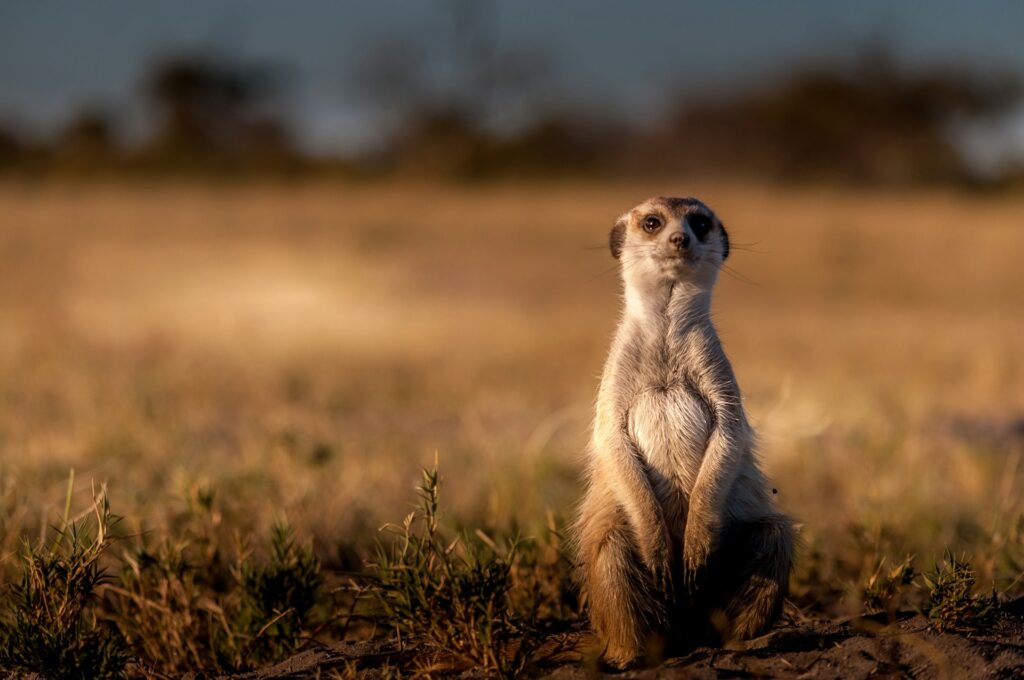
The meerkat, a member of the mongoose family, is native to the Kalahari and the surrounding semi-arid regions of southern Africa.
Meerkat colonies have a social structure of fascinating complexity, with designated sentinels, babysitters, and foragers.
They stand upright to warm themselves in the early morning sun, and on a cold Kalahari dawn with the red sand lit orange behind them, spotting a family of meerkats standing to attention is one of the more charming sights that the natural world gives us.
7. The camel thorn tree is the landscape’s defining plant
Acacia erioloba, the camel thorn, is the signature tree of the Kalahari.
It grows painfully slowly, lives for several hundred years, and provides food, shade, and nesting space for an extraordinary range of species.
Sociable weavers build their enormous communal nests in its upper branches, giraffe browse its canopy, and lions rest beneath it during the hottest part of the day.
They also make a great photography subject. A single camel thorn standing against the red dune horizon at golden hour is one of those images every photographer can be in awe of.
8. The gemsbok is a real physiological marvel
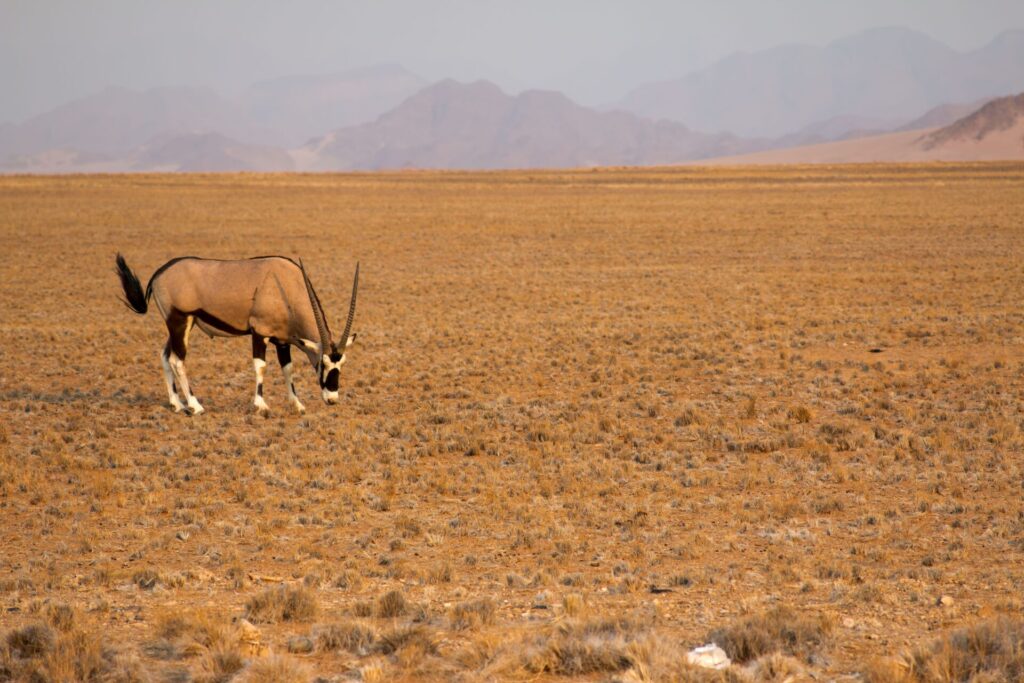
The gemsbok, or oryx, is one of the most perfectly adapted large mammals on Earth.
It can raise its body temperature to 45 degrees Celsius to reduce sweating in extreme heat, cooling only the blood supply to its brain through a specialised nasal network, and it can survive for extended periods without drinking water, extracting moisture directly from the plants it eats.
The Kalahari produced this animal, and that fact alone says something about what this landscape demands of the creatures that live in it.

9. The red sand gets its colour from iron oxide
The characteristic red colour of the Kalahari’s sand comes from a thin coating of iron oxide on each individual grain, built up over millions of years of oxidation.
The colour intensifies in areas where the sand is older and the oxidation more advanced, which is why the Kalahari’s reds can turn from pale apricot to deep burnt sienna across a single afternoon, depending on the angle of the light and the time of day.
10. The Kalahari is made for slow travel
The Kalahari is not a destination for the impatient, and it does not produce drama on command.
What it does do, for those who stay long enough and pay close enough attention, is something considerably more valuable than giving them a checklist of sightings.
It gives travellers a taste of how the world once was and perhaps how we should return to being: present and unrushed.
This land is still, but it is not empty. It has been doing the same thing for millions of years, and is entirely indifferent to being observed. That indifference, oddly, is what makes it worth visiting.
Now that you know the Kalahari Desert facts, you can start planning your tour.
The Kalahari forms part of several Namibia Safaris itineraries through the country’s southeastern region, and so it is a natural entry or exit point on routes that continue north through the Namib Desert, Damaraland, and Etosha National Park.
For travellers who want to experience the Kalahari as more than a drive-through, we can build a slow and indulgent itinerary that this landscape deserves.
The Kalahari is technically classified as a semi-arid savannah rather than a true desert. Annual rainfall ranges between 150 and 500 millimetres depending on location, which exceeds the 250 millimetre threshold that defines a true desert. Geographers describe it as a fossil desert, a landscape that carries the physical form of an ancient arid past while supporting significant plant, animal, and human life in the present.
The Kalahari Basin spans approximately 2.5 million square kilometres across seven countries: Botswana, Namibia, South Africa, Zimbabwe, Angola, Zambia, and the Democratic Republic of Congo. The continuous red sand surface covers around 900,000 square kilometres, making it one of the largest sand surfaces on Earth.
The Kalahari supports lion, cheetah, leopard, brown hyena, gemsbok, springbok, wildebeest, eland, meerkat, bat-eared fox, Cape fox, and over 200 recorded bird species. The Kalahari lion is particularly notable for its dark, full mane, which is more pronounced than that of lions in East Africa and is considered a marker of genetic fitness.
In Namibia, the Kalahari is known for its red sand dunes along the southeastern border, its populations of gemsbok and springbok, and its extraordinary night skies. The region forms part of several Namibia safari itineraries, typically as a starting or ending point on routes that connect the southern desert landscapes with the dune fields of the Namib and the wildlife of Etosha National Park.
Yes, particularly for travellers who appreciate landscapes that reward attention rather than announce themselves loudly. The Kalahari’s combination of ancient San culture, distinctive predators including the black-maned lion, extraordinary night skies, and a quality of silence that is genuinely rare in the modern world makes it one of the more quietly compelling destinations in southern Africa.
